Featured

Why Is Math Hated? (And How To Fix It?)

-By Vanshika Paharia

“In a world where everything involves math, from your tangled earphones to the strands of hair on your head- you can love it or hate it, but you cannot ignore it.”

-Someone who herself hated math always

But the terrible fact is that 24% students hate math and 30% are indifferent to it. In today’s date, your profession doesn’t matter. Math is a must and knowing mathematical and statistical concepts is a requisite. From integration and how to derivate a formula or solving an equation through synthetic division- math is necessary. Yet, math is the most disliked subject.

What we never sit down to dissect – why is math passionately hated throughout the world? When mathematicians and the remaining 46% of the students are able to find magic in math, why can’t everyone? Hence, I decided to think and mull over this. And came up with a few interesting points. Now, I can’t make you love this subject in one day but I can certainly tell you how to fix this hatred for it. I think you will learn to love math later through our blogs as we progress with the year at MSCNM.

De-mystifying maths – tackling students' fears and making maths clear |  Gordon Franks Training
Credits: gordanfrankstraining.co.uk

Why Do People Hate Mathematics and Statistics?

We can say, “I don’t like Maths and Stats. That’s it. No reason at all,” all we want. But that will not make it true. I am listing quite a few reasons here and trust me, one of them will be relatable.

1. Fear: Fear is a deadly feeling. And the fear of being wrong is even more catastrophic. Unlike English and creative writing, mathematics cannot have 5 different answers to everything. Only one answer is correct and the fear that you may get that answer wrong opens your mind to the prospect that you are not always correct and are imperfect.

That one wrong answer can haunt you. Especially if you know that seldom, if the answer goes wrong in an exam when it shouldn’t, it can make or break you. This fear gets turned into deflection, which turns into hate later. It is very important to remember that wrong answers are not a bad thing and they don’t mean you are not worthy. We will come to the solution for this later. This is the biggest problem you can face with math.

2. Conceptual Issues: In our life, we had that one moment when a teacher was teaching a math concept and our attention got diverted. Or maybe that teacher was just not that good. I get it, her fault. But later, it was your fault for not revisiting the concept when you missed it out.

Such concepts find place in bigger and more important math sums. And when we try these math sums and are not able to solve them, we panic and avoid. Eventually, we hate it. The trick is to do a root cause analysis there itself and go back to revisiting the concept. More on this later.

3. Laziness: Innate laziness in every person makes them to not want to solve sums unless they have a calculator on stand by. This is a problem because unless you take efforts to solve sums, you will never like them. Solving sums requires presence of mind and proactiveness, and thus a lack of it can result in sums going wrong. You will soon find yourself in a loop of laziness and a fear of going wrong.

4. Boredom: Most people, while studying math, don’t relate it to the outside world. They do not understand the applications of math, leading to boredom. All they see is numbers and not what the numbers can do. This can also be termed as lack of connection and relatability.

5. Lack of Simplicity: What most teachers, books and articles don’t do is simplify math. They say the same thing in such a twisted way that none can understand. “The summing of infinite numbers between 2 numbers through a certain equation” – sounds easy right? It is nothing but integration. One of the “toughest” to grasp concepts. It all depends on the material you are reading and trying to understand. If you deep dive into the blue cheese, it will always taste bad. Try the normal cheese first, study math in simple words first.

6. Incapability to Remember: Maths and Stats use a lot of rules and formulae. Remembering them is important and most people cannot do this due to lack of presence of mind. This is also directly related to messed up concepts. Mugging up does not work in maths, concepts do.

7. Lack of Practice: Lack of practice is honestly the worst. You may not know this but lack of practice is the causation of all the other 6 reasons. It is deadly and thus, all the other 6 problems must be fixed immediately. The other 6 are a root cause of this problem.

Fixing it

I know the problem now. How to fix it?

The effectiveness of this solution will depend on your perseverance and mental strength. Your will to make amends and to learn plays a huge role. Do these and I assure you, 95% of the times it works for willing and hardworking people.

1. Eliminate the Fear: Mathematics involves making a lot of mistakes and making mistakes is scary. But it is a part of learning. This is something you have to tell yourself every time a sum goes wrong. Your work is to try the sum again and work on your mistake. Someone told me, “Making a mistake in a sum is not wrong. But if I give you one more sum of the same type to try, you should be able to solve it. It is called learning from your mistakes.” Learn from your mistakes, review your errors and let them go. Also, accept that you are a normal human being and not Shakuntala Devi. I am sure even she made mistakes. Also, sums going wrong is due to less practice. Funny how lack of practice can find its place in fear too. Self pep talks, practice and learning is important.

2. Clear your Concepts: Cannot solve a sum or making an error? Go back, read and understand the concepts. Stop cutting corners and trying to solve sums without clearing your concepts. Cannot solve integration? It is because you don’t understand derivatives. Cannot understand derivatives either? Probably because you don’t understand what limits are. Perform a root cause analysis. Maybe even go through all basic concepts.

3. Stop being lazy: You cannot understand even the M of Math if you don’t want to try. Chuck the calculator and solve a few basic sums everyday. It will improve practice, will be fun, will reduce errors and will improve speed and thinking. At least, try some Logical Reasoning MCQs online.

4. Bye Boredom: Math is boring? Listen to music while solving Math. Will be less boring. Other than that, go understand the application of Math. Also, allow me to recommend you a few math based books and movies that will truly help you connect more-

  • The Man Who Knew Infinity – Movie
  • Shakuntala Devi – Movie
  • The Imitation Game – Movie
  • The Man Who Loved Only Numbers by Paul Hoffman – Book
  • The Black Swan by Nassim Nicholas Taleb- Book
  • Pi – Movie
The Man Who Knew Infinity (2015) - IMDb
Source-imdb.com

5. Simplify: Complicated math language- go search on the net for basic understanding. Or watch some comprehensive videos.

6. Incapability to remember– Practice more. Mugging up is not necessary. You will start remembering everything if you keep practicing. Even while solving sums or learning- presence of mind is required. Do not multitask.

7. Practice makes a man perfect– Fix the other 6 issues, I think 80% of your issues will disappear automatically. Take out time everyday just to practice mathematics.

PrACTice like a Champion.”

Trust me, there is no running away from math. Every CA, law or political studies student thinks his or her stream is an escape from math. 5 years later, they find themselves preparing for some post graduate entrance which requires math skills. Also, no one is “not a math person”. Everyone was born a lump with no likes or dislikes. If you cannot run away from it, beat it. Over a course of the next few months, we will tell you why math is important, with an aim to increase your understanding of the subject.

Quick Vedic

Though sacred text maths evokes Hindutva connotations, the very fact is that it is a system of straightforward arithmetic, which might be used for tangled calculations.

— (Credit: Ajit Ninan)NO ONE raises a hair once kids are needed to study multiplication tables until nineteen. Then, throw a match if students are instructed a way to multiply 199 by 199 while not resorting to multiplication tables, just because the strategy used is sacred text mathematics?

The revivification of interest in sacred text maths passed off as a results of Jagadguru Hindoo Sri Bharathi avatar Tirthaji Maharaj business enterprise wrote a book on the topic in 1965. The erstwhile Bharatiya Janata Party government in state, Madhya Pradesh, Rajasthan and Himachal Pradesh then introduced sacred text maths into the varsity course of study, however this move was perceived as an endeavor to impose Hindutva, as a result of sacred text philosophy was being projected because the repository of all human knowledge. The following hue and cry over the teaching of sacred text maths is especially as a result of it’s come back to be known with Protestantism and obscurantism, each thought-about the polar opposite of science. The critics argue that belief in sacred text maths mechanically necessitates belief in Hindu renaissance.

But is that this argument valid? it’s long been famous that the richness of Indian arithmetic extends on the far side the invention of zero. Avatar Tirtha is attributable with the invention of sixteen mathematical formulae that were a part of the parishishta (appendix) of the Atharva Vedic literature, one amongst the four Vedas (See box). Tirtha’s easy formulae build tangled mathematical calculations attainable. Besides dashing up variety of mathematical procedures, Tirtha’s formulae cowl factorisation; highest common factors; coinciding, quadratic, boxlike and biquadratic equations; partial fractions, geometry, and differential and the calculus (See box). However Tirtha isn’t while not his critics, even except for those that take into account sacred text maths is “unscientific”.

So, not all of Tirtha’s work is laid-off as elementary. Abundant of it is pure mathematics in nature and enhances process skills that have sizable pedagogic price.

Tirtha’s work contains decent examples to discount complaints that it’s simply a bag of process tricks, however it’s true that the supposed appendix to the Atharva Vedic literature isn’t to be found in any living text. sadly, Tirtha ne’er set down in complete kind the sixteen formulae that were presupposed to lie on the far side the process ways used. The sole references are to abbreviated forms. It is conjointly true that the techniques in Tirtha’s book regarding division and revenant decimals aren’t to be found within the work of early Indian mathematicians. However, Tirtha’s techniques regarding squares, sq. roots, cubes and cube roots follow the acquainted work of Aryabhata I, Sridhara (750) and Bhaskara II.

Two potentialities arise from all this: Either Tirtha discovered lost elements of the Atharva Vedic literature or he should have evolved the formulae himself, which might build him a larger man of science than he claimed to be. In either case, it’s impertinent to dialogue whether or not the kindulae form a part of the appendix of the Atharva Veda; what’s vital is whether or not the formulae are helpful — and on now, there is no dispute.

Rich tradition
Even on the far side Tirtha’s work, there’s a case being created for a better examination of ancient Indian arithmetic. As a result of Aryabhata’s technique of decisive sq. and cube roots and Sridhara’s and Bhaskara II’s formula to work out cubes ar all way faster than the standard ways, why should not they be used? Why should not students be instructed Bhaskara II’s and Brahmagupta’s ways of determination equations?

Mathematical Reasoning

Let’s relate math with literature and start our journey towards showing the existence of mathematics in all aspects of life. ~Vansh Jatin Mehta

Mathematically acceptable Statements.A Statement is a sentence which is not an order or an exclamatory sentence and of course a statement is not a question.

For example.What is your name? Get out of the room.Hurrah!we won.These are not statements.In the context of mathematics statement is only accepted as a statement if it is either true or false in short if it is conclusive.There is no space for ambiguous statements to be accepted as statements in context of mathematics.

Now what do you mean by ambiguous statements?The word ‘ambiguous’ needs some explanation. There are two situations which make a statement ambiguous. The first situation is when we cannot decide if the statement is always true or always false.

For example, “Tomorrow is Sunday” is ambiguous, since enough of a context is not given to us to decide if the statement is true or false.

The second situation leading to ambiguity is when the statement is subjective, that is, it is true for some people and not true for others. For example, “Cats are intelligent” is ambiguous because some people believe this is true and others do not.Now since we are aware of ambiguous statements there must be unambiguous statements (obviously the mathematically acceptable Statements).

Now the next question arises is what are the tools to establish conclusion in unambiguous statements.The main logical tool used in establishing the conclusion of an unambiguous statement is deductive reasoning. To understand what detective reasoning is all about let us begin with the Puzzle for you to solve.Suppose you are given 4 books.

And your told that these books follow the rule. Front cover has name of subjects and back cover has the colour.” If the back cover is red it implies that the book is math”.What is the smallest number of books you need to turn over to check if the rule holds true.Of course you have the option of turning over all the books and checking.

But can you manage with turning over a few number of books?

Notice that the statement mentions that if the back cover of the book is red then the book is math. It does not mention that every math book should have its back cover red. It may or may not be true. The Rule also does not state that Non- math book must have a colour other than red only.It may or may not be true.So out of the four books given to us how many should be turn?

So do we need to turn ‘math’?No, whether there is red or other colour in the back it doesn’t matter as the rule will still hold true.

Also what about ‘green’? No , as it won’t matter if it is math or other subject on the other side as the rule will still hold true.

But you need to turn ‘red’ and ‘science’.If ‘red’ has other subject in the front cover the the rule has been broken .

Also, if ‘science’ has red in its back cover then the rule has been broken.

The kind of reasoning we have used to solve this puzzle is called deductive reasoning. It is called ‘deductive’ because we arrive at (i.e., deduce or infer) a result or a statement from a previously established statement using logic. For example, in the puzzle above, by a series of logical arguments we deduced that we need to turn over only ‘science’ and ‘red’.Deductive reasoning also helps us to conclude that a particular statement is false, because it is a special case of a more general statement that is known to be false.

For example, once we prove that the product of two even numbers is always even, we can immediately conclude (without computation) that 674839394 × 42637482 is even simply because 674839394 and 42637482 are even.

Deductive reasoning has been a part of human thinking since Adam and Eve.For example “iceberg in Antarctica will melt only if if the temperature touches 104 degree fahrenheit”. And “iceberg started melting in antarctica from today” This implies that today the temperature has touched 104 degrees fahrenheit.

And since we are human beings we always have misconceptions in our daily life. For example:If your Crush smiles at you you conclude she likes you.While it may be true that “the girl smiles at you implies she likes you” on the other hand, it may also be true that ” if she smiles at you, you look like a joker”.

Why don’t you examine some conclusions that you have arrived at in your day-to-day existence, and see if they are based on valid or faulty reasoning?

Unravelling the Fibonacci Sequence

-Hetvi Sanghavi Vora

Fibonacci believed to be some secret code that manifests the architecture of the universe, is a sequence of numbers in which a given number is the result of adding the two numbers before it. Starting with 0 and 1, the series proliferates into 0, 1, 1, 2, 3, 5, 8, 13, 21, 34, 55, 89, and 144 and so on. What’s so special about these series? This is the pattern that functions the creation of living beings in this universe. Take a look around at Nature. You will see this pattern appearing in flowers as it is easy to notice.

Fibonacci Spiral

When squares with sides as the units in the Fibonacci Sequence like squares of units 1, 1, 2, 3, 5, and 8 are constructed and placed beside each other in a manner that makes a rectangle would result in a spiral when diagonal ends are connected with the help of a compass forming a continuous length in the form of a spiral which is called as the golden spiral.

When you divide two adjacent numbers in the Fibonacci sequence, you get either 1.61 or 0.1618. For example, 89/55 is 1.618. In the Fibonacci sequence, any given number is approximately 1.618 times the preceding number, ignoring the first few numbers. Each number is also 0.618 of the number to the right of it, again ignoring the first few numbers in the sequence. These are called Phi and phi respectively. Also called the Golden Ratio or the Divine Proportion, in mathematics, the irrational number (1+√5)/2, is often denoted by the Greek letter ϕ or τ, which is approximately equal to 1.618.  We find the golden ratio when we divide a line into two parts so that the long part divided by the short part is also equal to the whole length divided by the long part.

(a+b)/a = a/b = Phi = ϕ is the formula for golden ratio.

 Fibonacci in Flowers-

The pattern of seeds of a sunflower forms the classic Fibonacci Spiral. The number of petals of flowers is always a Fibonacci number. If you are wondering how Fibonacci flowers create such perfect floret arrangements, then the answer lies in the plant hormone called ‘auxin’. The growth hormone, auxin, helps in the growth and development of leaves, flowers, stems, and other plant parts. The plant grew where the auxin flows and interacts with other proteins. And since the hormone flows in the plant in a spiral direction, the plant grows spirally, leading to “Fibonacci spirals” in sunflowers.

Lilies and Irises have 3 petals, buttercups and wild roses have 5 petals, delphiniums 8 whereas Michaelmas daisies have 55 or 89 petals. All these are Fibonacci numbers.

Mathematician Leonardo Bonacci discovered the Fibonacci sequence. The mathematical equation it is Xn+2= Xn+1 + Xn. We see this pattern appearing in snail shells, pineapples, pinecones as well as images of nebulas and galaxies that depict the Fibonacci pattern. The cochlea of the inner ear forms a Golden Spiral according to this pattern.

Fibonacci in Music

The Fibonacci sequence of numbers and the golden ratio are manifested in music widely. The numbers are present in the octave, the foundational unit of melody and harmony. Stradivarius used the golden ratio to make the greatest string instruments ever created. Therefore it is the universal matrix on the fabric of which nature is created.

The Fibonacci sequence nicknamed ‘nature’s code’, was used by Mozart as he arranged his piano sonatas so that the number of bars in the development and recapitulation divided by the number of bars in the exposition would equal approximately 1.618, the Golden Ratio. In one sonata by Mozart, The exposition consists of 38 bars and the development and recapitulation consist of 62. The first movement as a whole consists of 100 bars. Here as well, 62 divided by 38 equals 1.63 (approximately the Golden Ratio).

Out of the13 keys in an octave, a major scale can be created in that octave using 8 notes. Within that major scale the 1st, 3rd, and 5th notes create the most basic major chord. Starting with Chord C Major that is made up of Sa Ga Pa or Do Mi So till Chord B Major the same numbers of 1, 3, 5, 8 are followed. Also, the ratio of white to black keys within an octave is 8:5. The ratio of which is 1.6.  The pentatonic scale has five notes, the Diatonic scale has eight notes, and the Chromatic scale has thirteen notes which are all Fibonacci numbers.

Another relation to music from the Fibonacci sequence is how musical instruments are created. Φ was used to create Stradivarius violins, the most sought-after and expensive violins in the world, one of which sold for $3.6 million (Stradivarius Violin Price, 2020). The violinmaker ensured the proportion of the neck, pegbox, and scroll to the body of the violin (upper bout, waist, and lower bout) achieves the ratio. Also, subdivisions of the instrument – waist to the upper bout, waist, and upper bout to those sections plus the neck – meet the 1.6 ratios as well.

Fibonacci in Art and Architecture

Well, the sequences have been found widely in architecture as well as medieval sculptures. The human face, by averages, follows the Golden Ratio in where the eyes, nose, and chin are positioned. The proportion of DNA molecules, 34 by 21 angstroms, fit the ratio as well. The pyramids of Egypt follow some unknown mysteries as per the Golden Ratio. This is also how many companies design their logos. Apple’s logo is a classic example of the same. This is used in art, architecture, and sculptures for ages.

The pentagram which is famous as a magical or holy symbol has the Golden Ratio in it.

Conclusion

Thus the Fibonacci sequence has been observed in many aspects such as nature, art, architecture, music as well as nebulas and galaxies. This is Mysterious Maths which is cherished by nature. That’s not all the ways this proportion has been used in trading and coding has been exceptional too. Have you encountered this divine proportion?

References-

  1. https://www.livescience.com/37470-fibonacci-sequence.html
  2. https://www.classicfm.com/discover-music/fibonacci-sequence-in-music/#:~:text=The%20Fibonacci%20Sequence%20in%20music&text=%E2%80%93%20An%20octave%20on%20the%20piano,and%20five%20are%20black%20keys.&text=%E2%80%93%20In%20a%20scale%2C%20the%20dominant,that%20make%20up%20the%20octave.&text=These%20are%20all%20numbers%20in,%2C%205%2C%208%2C%2013
  3. https://www.classicfm.com/discover-music/fibonacci-sequence-in-music/
  4. https://etd.ohiolink.edu/apexprod/rws_etd/send_file/send?accession=oduhonors1620086748612102&disposition=inline
  5. https://auralcrave.com/en/2020/06/28/the-golden-ratio-in-music-the-songs-of-fibonacci-sequence/
  6. https://www.mathsisfun.com/numbers/fibonacci-sequence.html
  7. https://mathworld.wolfram.com/FibonacciNumber.html
  8. https://www.classicfm.com/discover-music/fibonacci-sequence-in-music/
  9. https://www.benningviolins.com/fibonacci-series-and-stradivarius-instruments.html#:~:text=It%20also%20was%20the%20basis,of%20the%20two%20preceding%20it
  10. http://www.eniscuola.net/en/2016/06/27/the-numbers-of-nature-the-fibonacci-sequence/
  11. http://www.eniscuola.net/wp-content/uploads/2016/06/Pdf_TheNumbersOfNature.pdf
  12. http://www.maths.surrey.ac.uk/hosted-sites/R.Knott/Fibonacci/fibnat.html
  13. https://www.pansymaiden.com/flowers/types/fibonacci-flowers/
  14. https://www.rnz.co.nz/national/programmes/afternoons/audio/2018690395/maths-and-dance-combine-in-the-fibonacci
  15. https://www.creativebloq.com/design/designers-guide-golden-ratio-12121546
  16. https://www.nationalgeographic.org/media/golden-ratio/ 

Crime + Mathematics = Crimatics

Fighting crime — perhaps not the first thing that springs to mind when you think of maths. Ask someone on the street what they think about maths and unfortunately their answer may as well be: “Maths is boring”, “Maths is exact”, “Maths is irrelevant”, or even “Maths is scary”.

Does this scare you?

Apart from the last point, maths may seem very different and world apart from the confusing, unpredictable and highly relevant business of fighting crime. But, in fact, maths is very relevant. It is integral to many of the methods police use to solve crime, including dealing with fingerprints, accident and number-plate reconstruction and tracking down poison.

Challenges facing the police:

Police are faced with many challenges while tackling a crime. They must find out what happened at the scene of the crime or accident. They need to interpret confusing data which also needs to be stored and mined for information. And in the interests of justice, the evidence-both physical and electronic, must be kept secure.

Mathematics can help with all of these. Data can be stored and interpreted using wavelets, probability and statistics. It can be securely transmitted using prime numbers and cryptography. But first of all, the police must get at the information underlying the data. They must look at all the evidence left at the crime scene and work backwards to deduce exactly what happened.

Often, the evidence is a result of a physical process that is well understood — like a speeding car causing skid marks. So to find out the exact cause of the evidence — the speed of the car — the maths that describes the physics needs to be run backwards. This is called solving an inverse problem, and in this blog we will explore three examples of how it is done.


This blurred fingerprint is all the
police may find.


Running the blurring process backwards,
maths can clear up the fingerprint.

What happened at a crime or accident scene given the evidence?

Inverse problems are mathematical detective problems. An example of an inverse problem is trying to find the shape of an object only knowing its shadows. Is it possible to do this at all? What sort of errors are we likely to make, and how much extra information is needed?

To solve an inverse problem, we need a physical model of the event — we need to understand what causes lead to what effects. Then, given the known effects, we can use maths to give the possible causes, such as deciding what shaped objects cast the shadows in this photo.

We also use maths in this situation to establish the limitations of the model and accuracy of the answer. In the example of shadows cast by objects, different causes (different shaped objects) may give very similar effects (cast similar shadows)!

Other examples of inverse problems are remote sensing of the land or sea from satellite images, using medical images for diagnosing tumours, and interpreting seismographs to prospect for oil.

Mechanics fight CRIME

Let’s step into an ordinary day in the life of a police unit and see how mathematics can help fight crime. First up, we are investigating a car accident and need to answer the question: was the car speeding?

The evidence available is the collision damage on the vehicles involved, witness reports, and tyre skid marks. Just like on television, examining the skid marks can help reconstruct the accident. The marks are caused by the speed of the car as well as other factors such as braking force, friction with the road and impacts with other vehicles.

Mathematically we can use mechanics to model this event in terms of ‘s’, the length of the skid, ‘u’, the speed of the vehicle, ‘g’, the acceleration due to gravity and ‘µ’, the coefficient of friction times braking efficiency. The model links the cause (the speed of the car) to the effect (the distance of the skid):

This can be rearranged so that given the skid distance we can mathematically determine the speed of the car, usually giving a lower bound:

But for this to work, we need to have an accurate estimate of µ, the value describing friction and braking efficiency!

Where is the poison?

Meanwhile, somewhere a contaminant has been illegally released into the water network. Some time later, when the police have been alerted of the contamination. Can we find where it was released?

The water network

To find where the contaminant was released, we need to model how the water and contaminant flow through the network. The contaminant is  diluted by the flow of water through the pipes. It reacts with the material of the pipe walls and decays due to other chemical reactions. All these processes cause the concentration ‘c’ of the contaminant to decrease, and this decrease can be described by a negative quantity –KC. What kind of things does -KC depend upon?

Well, obviously there is a time factor; the concentration of the contaminant changes with time, and we call this change C_T. But the contaminant also reacts to the space it is in — the pipe — and this reaction is influenced by the volume and flow of the water. Writing Q for the water flow and C_X for changes in the concentration effected by the surrounding space, we get a mathematical model for the overall loss in the concentration of the contaminant:

Also, at each junction, the different solutions flowing through the two pipes get mixed together:

The solution from two pipes is mixed at the junction to give a new concentration of the contaminant.

To reconstruct what is happening in the water network, we need to find the flow rates in the pipes and measure the present contaminant concentrations at the junctions. Then we can make a guess at the initial contaminant concentrations (at each junction), and flow the model forward in time and compare it with what we measure now in the real network. Using a process called nonlinear optimization, we can adjust the initial concentrations until the present concentrations predicted by the model agree with our measurements.

A circulation path in the network means that we can
only come up with several possible causes for the
contamination.

For a simple pipe network we can solve the model for a single possible cause — and find exactly where in the network the poison was released. However, for more complex networks where there are circulation paths, we may come up with several possibilities for how the network was contaminated.

Catching the getaway car

Meanwhile, across the other side of town, someone has robbed a bank. Although he escaped in a getaway car, he was pursued by police. The good news is the police managed to take a photo of the number plate of the car, but the bad news is that the photo is blurred.

Simulated original
Blurred photograph

But never fear, mathematics to the rescue again! We can mathematically model the blurring process and remove some of the blur to get a clearer picture of the plate. The model involves a blurring function, g, that is applied to the original image to give the blurred image.

A formula that describes the process of blurring looks like

Here, the variable x describes the various pixels in the image. Each pixel has its own number, called the pixel value, which gives information on its colour and brightness. The function f(x) gives the pixel value of each pixel x before blurring, and h(x) is the pixel value after blurring. Running the formula above backwards will give us the unblurred image given by f(x) from the blurred image h(x).

But as in the other examples we need to understand the model well, and we can only deblur the image if we know the blurring function g.

The deblurred image

Crime might not pay, but maths does!

So the neat tricks TV cops use, such as deblurring number plates and reconstructing accidents from skid marks, are not as far fetched as they seem. In the fight against crime for both TV cops and the real police force, the secret weapon is mathematics.

REFERENCES:

http://www.researchgate.net/publication/225344454_inverse_problem_in_hydrology

http://www.plus.math.org

https://s3-eu-west-1.amazonaws.com/content.gresham.ac.uk/data/binary/1854/mathsandcrime1.ppt

Rare events happen all the time!

Ali Hyder Mulji

If you rearrange the letters in the word William Shakespeare you can spell ‘here was I like a psalm’. In the book ‘King James Bible’ in Psalm 46, the 46th word is ‘shake’ and the 46th word from the bottom is ‘William’.  Coincidence…? Yes!

The Banality of Improbable Events.

It is funny to think how improbable events leave us mystified but it is important to understand that the amount of data humans have is massive and if you look long and hard such events will be found easily.

The book ‘Futility’ also known as ‘The Wreck of the Titan’ describes a 800ft long ship with four funnels and three propellers and not enough lifeboats to save all the passengers. The ship was believed to be ‘practically unsinkable’. It was the largest ship in the world with the finest luxuries and a handpicked crew. The ship hit an iceberg in the North Atlantic, broke in half and sank, killing most of the people on board. Few of the survivors were carried to safety by a steamer that reached the spot later.

One might think the book was based on Titanic because of its uncanny similarity but this book was actually written fourteen years before the actual Titanic sank. The book even described the orchestra that continued to play as the passengers dived into the chilling water.

Again, this is a mere coincidence just like the movie ‘contagion’ which many claimed, predicted the coronavirus. It is hard to imagine that these occurrences have no real connection to each other but with a few examples we can see how ‘improbable things happen all the time’.

Creating a Rare Event: The Baltimore Stockbroker.

The Baltimore Stockbroker is a story of the broker who could predict exactly where a stock would move in the market. This may sound fishy but the Baltimore Stockbroker only asked you to put in a large sum of minimum investment if he got ten correct predictions in a row. Obviously, if someone can predict where the stock moves ten times in a row anyone would believe in him. 

However, just like our other two events, this was merely the mathematics of coincidence. 

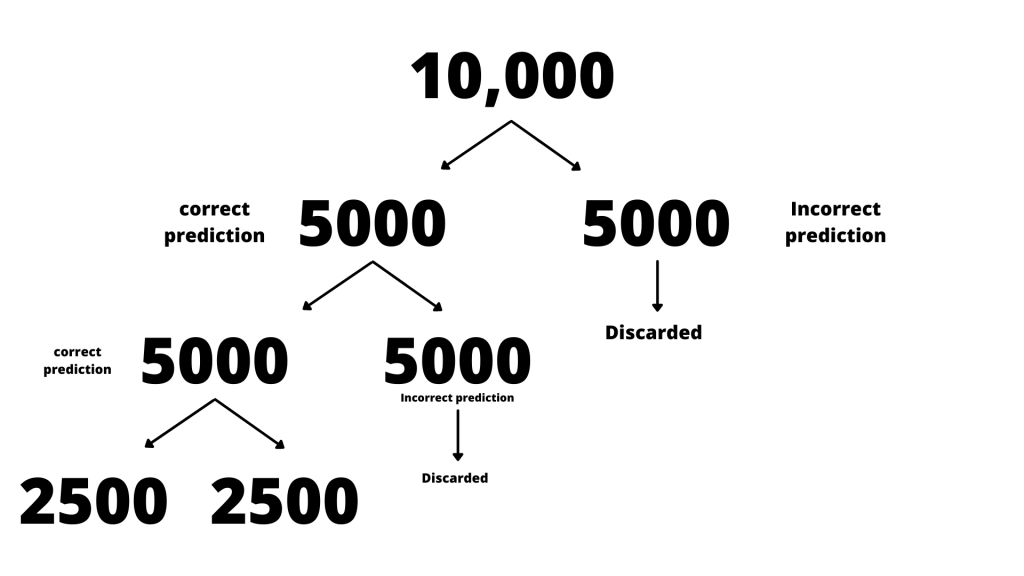
The Baltimore Stockbroker would send out a letter to 10000 prospective clients. 5000 of them would say that a stock will go up and the other 5000 would say that the stock will go down. Obviously, after a week the stock will have moved in either of the two directions. If the stock moved up, the broker stopped contacting the ones who received the letter which said the stock would go down and continue contacting the ones who received the correct prediction.

Now, the broker would repeat the same exercise and send a letter to the remaining 5000 people. 2500 letters said the stock would go up and the other 2500 said that the stock would go down. Naturally, the stock moved in one of those two directions. This exercise was continued ten times every time leaving the broker with half the number of prospective clients. 

After 10 cycles, some people will have received 10 correct predictions and those (no matter how few) were ready to hand over a large sum of money because they believed in the brokers ability to predict. With a sufficiently large number of trials you will eventually arrive at your desired result (In this case, 10 correct predictions)

Equidistant Letter Sequences (ELS)

ELSs are another tool that people enjoy using to either fool others into believing something or fool themselves into getting entrenched in their own preconceived notions. Equidistant Letter Sequences are obtained by picking up one letter after a fixed number of letters to form a meaningful sentence. For example, I can make an ELS by picking a letter after every 50 letters from a novel and try to make a meaningful sentence. 

Eg: If I take every fifth letter starting from the first in the following sentence:

DON YOUR BRACES ASKEW 

The ELS will be DUCK.

Some rabbis used ELS to find secret messages in the Torah which they believed were sent by God. Unsurprisingly, they found several ELSs that predicted assassinations and major world events. The same process was repeated by another Catholic mathematics enthusiast to find messages in the Bible and claimed that it predicted the great war, therefore proving that God exists. You would think an omnipotent being would pull off something more spectacular to mark his presence than send secret messages through a book.

Conclusion

The crux of these practices is that if you try a sufficiently large number of combinations, by increasing your data you are sure to find some random sentence which will relate to another random event that occured in history or will occur in the future. This is the foundation on which fortune-tellers and astrologists make their living. In other words, it’s just a coincidence! As the volume of data increases so does the number of coincidences. It can be thought of as an extension of rare events that we experience in our usual lives like meeting someone with the same birthday as yours or dying on your birthday.

A Mathematical Ride!

-Simran.M.Karkera.

That girl with the pink scarf would always visit the amusement park for one ride, the roller coaster. For she saw something beyond the thrill and adrenaline rush, she saw Mathematics in it! All her friends mocked her for her crazy love for mathematics. However, she silenced all her critics in the most classic way and showed them how the very foundation of the roller coaster is based on math. She embarked on a journey of proving her point and in the process explained to her peers what you are about to read below!

1.Designing: The designing of the roller coaster begins with something as basic as sketching graphs! Engineers make use of computer aided design(CAD) to ensure accurate maps of the hills, the twists and turns etc of the roller coaster.

a)Thrill: The thrill of a drop is the product of the angle of steepest descent in the drop (in radians) and the total vertical distance in the drop. The thrill of the coaster is the sum of the thrills of each drop.

Few constraints/conditions are formulated when designing the thrill. For e.g.

  • The total horizontal length of the straight stretch must be less than 200 feet.
  • The track must start 75 feet above the ground and end at ground level.
  • At no time can the track be more than 75 feet above the ground or go below ground level.
  • No ascent or descent can be steeper than 80 degrees from the horizontal.
  • The roller coaster must start and end with a zero-degree incline.
  • The path of the coaster must be modeled using differentiable functions.

These conditions or constraints will ensure two things:

1) Safety of the ride is maintained.

2) The forces like gravity, inertia etc. are properly balanced to ensure a smooth ride.

Now, in order to calculate the steepest descent, we use derivatives. We find the maxima (using the 2 conditions i.e. f(x)=0 and f’’(x)<0). Then, in order to determine the angle of steepest descent, we convert slope measurement into angle measurement. Finally, after multiplying the 2 values we come to thrill of one single drop! Continuing in similar fashion, the thrill of each of the drop is determined and added to arrive at the thrill of the roller coaster.

Measuring the thrill of a roller coaster

b) Loops:

The formula used to design a loop is:

ac = v2⁄ r, Where,

  • ac is the acceleration,
  • v is the velocity and
  • r is the radius.

It is helpful to think of acceleration in terms of how many times the acceleration due to gravity is. So 1g is 10m=s2, 2g is 20m=s2, etc. At about 5-6g, especially upwards, a normal person will begin to pass out. So, the shape of the loops is to be chosen in such a way that the acceleration is not more than 4 or 5 mg. This becomes possible in a clothoid-shaped loop. The shape is a simple tear drop turned upside down with a radius more than that of the circular loops. This not just ensures less g-force but also helps in maintaining the sufficient speed required to keep the ride moving along the coaster.

A clothoid shaped loop

2. The Vehicle:

The girl explained, “Although this may seem as something to be very easy to make and simple, it is rather complex as all the working related to the thrill, safety and the path would fail if the vehicle is not designed properly!

Here it’s not just math that is used here but also her cousin physics!”

“Wait, why do you call physics math’s cousin?”, asked the confused friends.

 “For the simple reason that mathematics is a very important tool used in physics while physics is a rich source of inspiration and insight in mathematics. For example: Before giving a mathematical proof for the formula for the volume of a sphere, Archimedes used physical reasoning to discover the solution (imagining the balancing of bodies on a scale).”

Coming back to the point, the vehicular math is also as essential as the path’s mathematics.

a) Speed: Firstly, we need to understand that along-with with the gravitational force, the coaster will have 2 types of energy acting on it: Kinetic and Potential. When the ride descends from the peak, it is gravity that pulls the vehicle down. Now coming to the other two aspects, kinetic energy will be the highest at the lowest point of the track while potential energy is the highest at the peak of the coaster. These facts can be converted into equations which is: At the point x in the picture, the potential energy lost is mgy, so the kinetic energy at that point is given by:

Solving for v gives us a basic formula:

To find a formula for t, we must manipulate the above equation. Rewriting v in terms of its horizontal and vertical components, let:

  • s represent the accumulated distance along the curve,
  • ds represent a small increment distance along the curve,
  • dx and dy represent the horizontal and vertical components of ds. 

Substituting this into our basic formula:

Thus, t is:

We can use this formula on a roller coaster track with the equation:

Y=2cosx+sin2x

First we differentiate the equation:

To find time taken to travel from 0m to 1m:

Therefore the time taken to travel from 0m to 1m is about 0.24s

Finally, the speed will be the distance divided by time which in our example would be 1/0.24 m/second.

Mathematics is present everywhere around us right from the games that we play to the complex mechanisms and systems that operate in every country. You only have to take a deeper look at things and see how the magic of maths can turn things easier than you ever thought!

References:

https://www.intmath.com/help/snlabs/integr-proj4/integ-proj4.htm

659-Roller-Coaster-Math.pdf

https://www.teachengineering.org/lessons/view/duk_rollercoaster_music_less

Should You Buy A Lottery Ticket?

-Ali Hyder Mulji

Spending $2 to stand a chance to win $100million sounds like a deal only a numb nut would pass. Every single day millions of these deals are made in the USA and people happily participate. But have you ever wondered if the lottery is too good to be true? In this article we’ll be analysing the lottery system to understand if you should consider buying a ticket.

A lottery system works on a lot of probability and expectation! Maths and statistics is present in every bit of it. And looking at the lottery through the eyes of mathematical logic will be different.

Lottery Structure

To understand whether buying a lottery ticket is worth it we need to first analyse how a lottery system works. This is how most people think lottery works-

Whereas, a practical lottery system has several expenses that have to be paid from the earnings of ticket sales. Commissions, taxes and management expenses are all paid through the ticket earnings.

And whatever extra remains, goes straight to the government treasury (if the lottery is state sponsored). This is why lotteries are often called “tax on the stupid” because no sane person would stand in queues to pay any other tax.

Every lottery has a certain list of odds which gives you an idea of the probability of winning each prize. These are the odds for a $2 powerball ticket. 

To put things in perspective, you are more likely to be eaten by a shark or get struck by lightning than win the jackpot. 

But instead of just drawing analogies for the sake of argument, let’s get into the math of things. 

Expectation

Statisticians often use the concept of ‘Expectation’ to find out the average of the outcome of a certain event. It is very much like ‘mean’ except with the odds used as weights. All you have to do is multiply each probability with the corresponding prize and add all the results.

Using the odds table above, we arrive at 94 cents. This means that spending $2 on a powerball ticket is not worth it because the average earnings on each ticket is only 94 cents. 

If we reverse engineer the equation, you can actually calculate how big the pot needs to be to ensure that the expected value of your ticket is at least more than $2 and in this example it shoots up to $285 million. But that’s not all, as the jackpot increases so does the number of people participating, which increases the chances of having to share the winnings with another winner.

The Lottery that was worth it

Now let’s imagine a situation where the odds and prizes are set just right to ensure that the expected value of your ticket is more than $2 and it doesn’t even have enough sales to result in multiple winners.

This is exactly what happened in 2005 when the State of Massachusetts decided to tweak their lottery system because of discouraged participants and reduced sales. Instead of adding up the jackpot each time it went unclaimed, it was rolled down so the smaller prizes were made more attractive.

This means that if a million dollar jackpot was not won by anybody, the million dollars were adjusted in the smaller prizes of the next lottery. Now these smaller prizes became very valuable despite being easier to win.

James Harvey, an MIT senior, working on an independent project pertaining to various state lotteries was the first to find this out. When he calculated the expected winnings on each ticket on a roll-down day, it came out to $5.56. This means that on average a $2 ticket would have winnings of $5.56.

Now this does not mean that every ticket holder would receive $5 but instead makes the prizes much more attractive in terms of odds and winnings. The first thing James Harvey did was gather a bunch of friends and bought a thousand tickets and won a 1/800 odds prize and a few smaller rewards. In all, the friends tripled their investment. 

It wasn’t long before betting clubs started to see the benefits of participating when the previous unclaimed jackpot was rolled down and the smaller prizes were made more attractive. One of the betting clubs spent $300,000 worth on tickets. The ticket vendors were paid 5% commission on sale of tickets by the lottery organiser. One of the betting clubs made a deal with a ticket vendor to go halfsies on the commission in return for sales of several thousand dollars . Another couple from Massachusetts bought sixty thousand tickets and took home a pure profit of $50,000.

Conclusion

Lotteries are always made to ensure the state takes in much more than the distributed winnings. But from a participant’s perspective, no matter how low the odds maybe, someone is going to win and that someone could be you. This is what keeps people going. However, statistically, most people who win the lottery squander it before too long.

This is because the winner is most likely someone who doesn’t have financial acumen, which made him want to participate in the first place. It is important to remember that financial acumen doesn’t come by owning large amounts of money. Inestead, large amounts of money are a result of having financial acumen.

Sources: How to not be wrong – Jordan EllenbergIn the sources

Don’t Rain on my Pitch!

-Vanshika Paharia

Everyone hates rain. It dampens fun and isn’t always romantic. Especially in a sport like cricket, rain is a downer. Unlike football matches, cricket matches cannot be carried out in rain because of visibility issues, playing conditions, game duration and an unfair advantage that rain may provide to the other team. In countries like UK, rain is a frequent guest that results in match suspensions, delays and halts. Sometimes, the rain is so prolonged that covering the ground with sheets is not feasible. Matches are delayed and suspended due to a few other issues too, rain being the most common one. This was a major problem for limited over matches.

I simply gotta march

My heart’s a drummer

Don’t bring around a cloud

To rain on my parade!

-Don’t Rain on my Parade, Barbra Streisand
A typical cricket ground: rain can hamper the playing conditions drastically

Before 1992, a lot of methods were used to resolve cricket matches that were affected by rain. The Average Run Rate and Most Productive Overs Method were the most used methods. Although simple, both methods had intrinsic flaws that produced unfair revised targets for the team after the game resumed. 2 British statisticians, Frank Duckworth and Tony Lewis devised a method called the D/L Method in 1992 when rain left South Africa with an unfair revised target of 21 runs from 1 ball. Now famously known as the Duckworth-Lewis-Stern Method, it was adopted by ICC in 1999 for one day matches.

ICC releases updated version of Duckworth-Lewis-Stern (DLS) method | Green  Team

I recall hearing Christopher Martin-Jenkins on radio saying ‘surely someone, somewhere could come up with something better’ and I soon realized that it was a mathematical problem that required a mathematical solution.

Frank Duckworth
duckworth Lewis method

Involving mathematics and statistics to the core, D/L system has confused and troubled cricket lovers and fans since inception. With an aim to explain the calculation behind the method in an easy to comprehend manner, the article will hopefully be fun for you.

THE CONCEPT OF “RESOURCES’: According to the D/L Method, 2 resources exist that are closely correlated to the score that a team may make.

  1. The number of overs that are left in the match
  2. The number of wickets lost

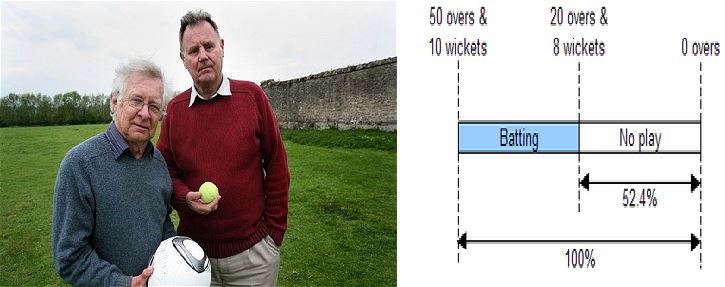
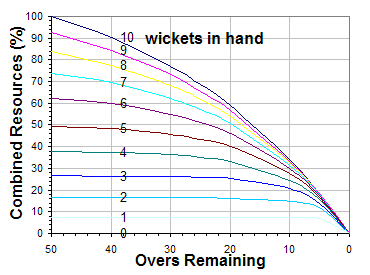
The D/L Method calculates the percentage of resources left using these two resources. E.g. If 50 overs and 10 wickets are remaining, percentage of resources is 100%. A pre published table is available that shows the percentage of resources for all 10 wickets and 50 overs. The actual resource values are calculated using a computer software. The target for the team batting 2nd (Team 2) is calculated up or down as a percentage of the resources used by Team 1 to reach a certain score.

DuckworthLewisDiag2
The number of resources used would be 100-52.4
DuckworthLewisDiag3
The number of resources used would be 100-77.8+52.4

A published table of the resource percentages for overs left and wickets lost

CALCULATION OF THE TARGET:

This is the version of D/L System used commonly for one day and first-class matches.

Team 2’s par score is the score that is considered on the same level as the number of runs scored by Team 1 in the first innings. Team 1’s score is the number of runs scored in the first innings. Generally, the result of this formula is a non integer. Thus, the par score is said to be rounded down and the target score is rounded up to the nearest integer.

Team 2’s resources and Team 1’s resources are the resource percentages. If Team 1 had all available resources in their innings and if game was not interrupted in the first innings, the denominator will be 1. (100% resources)

e.g. Rain interrupted the first innings and Team 1 used 90% of its resources to score 250. Now, rain interrupted the second inning and Team 2 has 80% resources. 250 * 0.8/0.9 will be 222.22 which means 222 is the par score and Team 2 needs 223 to win.

Scenarios: How the system works and how the score will be calculated depends on various scenarios.

  1. If the game is interrupted before the first innings, it would not matter because both teams will still have complete resources to score.
  2. In case of interruptions in the first innings but no interruptions in the second innings, the target score for Team 2 will be more than that of Team 1 to make up for the advantage that Team 2 has. This is because- if Team 1 had faced no interruptions, they could have scored more.
  3. In case of interruptions in the first as well as second innings, the target score will depend on whether the interruptions faced by Team 1 were more than those of Team 2 or more. Here, the percentage of resources makes sense.
  4. In case the second innings faces multiple interruptions, the target score is revised again and again and is lower every time.

MATH BEHIND THE RESOURCE PERCENTAGES: The D/L Model started off by assuming that the runs scored (z) are a result of an exponential decay relationship between the number of overs left and number of wickets lost. To keep matters relatively uncomplicated, we will not go into the depth of the calculations. Z0(w) is the asymptotic average runs with regards to the number of wickets lost and b(w) is the exponential decay constant.

The Decay Relationship
P(u,w) is the % of resources
Scoring potential as a function of wickets and overs.
The percentage of resources can be plotted on a graph as follows

OTHER INFO: The D/L table is updated every year on 1st July. For 50 over matches decided by DLS Method, a minimum of 20 overs must be played and for 20 over games, 5 overs must be played. If the minimum number is not played, the match is declared a no result.

  • Till 2003, the standard edition of the published table was used where no computer program played any role and the table was not updated regularly.
Standard Edition
  • In 2004, a new version was adopted where the resource percentage was calculated using computer software and the table was regularly updated. This version is also the “Professional Edition” which is now in use.
  • In 2009, D/L method was reviewed for its use in Twenty20 matches.
  • In 2015, the D/L method became the Duckworth Lewis Stern Method (DLS Method).

OTHER USES AND CRITICISM OF THE METHOD:

DLS Method is also used in:

  1. Ball-by-Ball Par Score: In case it is felt that the weather may interrupt the game again, the ball-by-ball par score is calculated using the D/L Method and it is shown on the scoreboard continuously.
  2. Net Run Rate Calculation: The NRR for a team is calculated using the DLS Method.

Criticism: The method is criticized on the grounds that the method gives a heavy weightage to wickets and thus in case of an unfavorable weather, a winning strategy would be to not lose wickets and to play at a losing rate.

Another criticism is that the D/L method does not account for changes in proportion of the innings for which field restrictions are in place compared to a completed match.

The VJD Method: Best Alternative to the DLS Method - The Cric Mania

Journalists and new channels have also claimed that the method is unduly complex and hard to understand. Thus, it can be misunderstood. But after reading this blog, we can hope that you understand the method much better and cricket seems more interesting to you now. Maybe next time when the match is interrupted and DLS Method is used to calculate a target score, it would not seem as unfair and stupid. Duckworth and Lewis did use their genius and revolutionized how cricket is played even during unpredictable circumstances.

REFERENCES:

https://en.wikipedia.org/wiki/Duckworth%E2%80%93Lewis%E2%80%93Stern_method

https://www.jagranjosh.com/general-knowledge/what-is-the-duckworth-lewis-method-and-how-is-it-applied-in-cricket-1497590244-1

https://www.thehindu.com/sport/cricket/in-cricket-how-does-the-dls-method-work/article27951348.ece

https://www.bbc.com/sport/cricket/48625085#:~:text=The%20rain%20drastically%20alters%20the,field%20on%20a%20slippery%20outfield.

GOLDBACH CONJECTURE

-Shreya Doshi

Mountain climbing is a beloved metaphor for mathematical research. The comparison is almost inevitable: the frozen world, the thin air and the implacable harshness of mountaineering reflect the unforgiving landscape of numbers, formulas and theorems . And just as a climber pits his abilities against the unyielding object in his case- a sheer wall of stone- a mathematician often finds himself engaged in an individual battle of human mind against the rigid logic. 

In mathematics, the role of the highest peaks is played by the greatest conjectures – sharply formulated statements that are most likely true, but for which no conclusive proof has yet been found. These conjectures have deep roots and wide ramifications. The search for the solution entails a large chunk of mathematics. Eternal fame awaits those who conquer it first.

Goldbach Conjecture Is one of the oldest and the best known unsolved problems in number theory and all of mathematics . It states that:

“Every even whole number greater and 2 is a sum of 2 prime numbers”

A modern version of the marginal conjecture is :

“Every integer greater than 5 can be written as a sum of 3 primes”

And a modern version of Goldbach’s older conjecture of which Euler reminded him is :

“Every even integer greater than 2 can be written as a sum of 2 primes”

Its very easy to state, but it seems very difficult to prove.

If you try it out via a small program you will very soon convince yourself that it works for any integer you care to use as a test case. However, this is not a mathematical proof and there may just be an integer out there waiting to be found that needs three or more primes in the sum.

There are a number of variations of the basic Goldbach’s conjecture that are often studied as a sort of warm up to the real thing. For example, the Odd Variant postulates that every odd number greater than 7 is the sum of three odd primes. This was proved, but the proof relied on a modification of the Riemann hypothesis – which is as yet  another unproven, well-known, challenge.

To date there have been a smattering of proofs that set bounds on the size of a number that disobeys the conjecture – every sufficiently large odd integer is the sum of three primes and almost all even integers are the sum of two primes. You might think that “sufficiently large” would mean that we could take a program and test the numbers up to the upper bound where the proof takes over.

Unfortunately the upper bounds are very “upper” , for example bigger than 106846168, which makes computational help still out of reach.

Now we have another proof that places a different sort of upper bound on the conjecture. Terence Tao, a Fields medalist, has published a paper that proves that every odd number greater than 1 is the sum of at most five primes. This may not sound like much of an advancement, but notice that there is no stipulation for the integer to be greater than some bound. This is a complete proof of a slightly lesser conjecture, and might point the way to getting the number of primes needed down from at most five to at most 2.

Notice that no computers where involved in the proof – this is classical mathematical proof involving logical deductions rather than exhaustive search.

So does this have any application to real world problems?

I doubt it, but number theory is so central to coding and cryptography. On another note, it is a demonstration that mathematics hasn’t fallen to computer-based constructive proofs just yet and perhaps there is still a neat one-page proof of the four-color theorem waiting to be written. 

Goldbach’s Comet One interesting phenomenon generated by the conjecture is the so called Goldbach’s comet which is a visual representation of the number of possible Goldbach partitions of an even integer n. The comet-like structure can probably be explained as a consequence of how the number of partitions varies between different congruence classes. Now this figure just expresses the number of partitions up to n = 5 · 104 , but we can clearly see that the number is steadily increasing. This would make us assume that the conjecture holds, but this has nothing to do with a proof as we can not know that there is no exception for a large n where the number of partitions will be zero.

Goldbach’s Comet, Goldbach partitions up to the integer n = 50000 on the x -axis, and number of partitions on the y-axis. This was generated by a Python script using a modified version of the code from [Sci].

Now, the original Goldbach conjecture can be proven. The original conjecture is as follows:

Every even integer greater than 2 can be written as the sum of two primes.

The mathematical derivation above caters for all even integers greater than or equal to 6. So, the only even integer greater than 2 not catered for is 4. And 4 can be expressed as 2 + 2. 2 is an even prime number but the Goldbach conjecture places no restrictions on the parity of the prime number. In other words, the prime number need not be odd. Therefore, it is indeed true that all even integers greater than 2 can be expressed as the sum of two prime numbers.

The point of such conjectures are often not the result themselves ; more often than not the knowledge of the veracity of such statements is completely uninteresting. The interest lies in the methods of proof to argue against such statements ; they often lead to developing new theories and inspire mathematicians to create new kinds of arguments which can then apply to other situations where they may hopefully be useful. It can be considered as a training ground for mathematicians.

References:

https://en.wikipedia.org/wiki/Goldbach%27s_conjecture#:~:text=Goldbach’s%20conjecture%20is%20one%20of,sum%20of%20two%20prime%20numbers.

https://artofproblemsolving.com/wiki/index.php/Goldbach_Conjecture

https://plus.maths.org/content/mathematical-mysteries-goldbach-conjecture

Room at the Hilbert Infinity Hotel

-Suchi Dagli

Imagine you are packing to stay at your favorite Hotel for a 3 nights 4 days stay, you are super excited and cannot wait to reach there. But to your surprise, you find out that the Hotel has NO VACANCY! That might be very disheartening for you. But when your favorite Hotel is “The Hilbert Infinity Hotel”: there’s vacancy even when there is no vacancy.

In the 1920s, the German mathematician David Hilbert devised a famous thought experiment to show us just how hard it is to wrap our minds around the concept of infinity. Hilbert’s paradox of the Grand Hotel ( Infinite Hotel Paradox or Hilbert’s Hotel) illustrates a property of infinite sets. It is demonstrated that a fully occupied hotel with infinitely many rooms may still accommodate additional guests, even infinitely many of them, and this process may be repeated infinitely often.

Imagine a hotel with an infinite number of rooms and a very hardworking night manager. One night, the Infinite Hotel is completely full, totally booked up with an infinite number of guests. 

How will you get a room?

You walk into the hotel and ask for a room. Rather than turn you down, the night manager decides to make room for you. How? Take a look at this.

He will ask the guest in room number 1 to move to room 2, the guest in room 2 to move to room 3, and so on. Every guest moves from room number “n” to room number “n+1”. Since there are an infinite number of rooms, there is a new room for each existing guest. This leaves room 1 open for you. This process can be repeated to accommodate any finite number of new guests like you!

Now what if you tell me that not one, but a tour bus unloads 70 new people looking for rooms, then every existing guest just moves from room number “n” to room number “n+70”, thus, opening up the first 70 rooms. 

Have you noticed where we’re going? 

∞ + N = ∞

Infinite buses with countably infinite people:

But the challenge isn’t over yet. Let’s say now an infinitely large bus with a countably infinite number of passengers pulls up to rent rooms. Now, the infinite bus of infinite passengers confuses and amazes the night manager at first, but he realizes there’s still a way to place each new person. 

This is how he does it:

He asks the guest in room 1 to move to room 2. He then asks the guest in room 2 to move to room 4, the guest in room 3 to move to room 6, and so on. Each current guest moves from room number “n” to room number “2n” — filling up only the infinite even-numbered rooms. 

By doing this, he has now emptied all of the infinitely many odd-numbered rooms, which are then taken by the people filing off the infinite bus. 

However, the business, if one might look at it, is booming the same as ever, banking an infinite number of dollars every night. 

The very popular Hilbert Hotel:

Sooner or later, the popularity of this incredible Hotel increases and people, like you and me, start coming in from far and wide. Now one day the night manager looks outside and sees an infinite line of infinitely large buses, each with a countably infinite number of passengers. What can he do? He cannot lose out on an infinite amount of money!

 Now remember  what Euclid proved that around the year 300 B.C.E., that there is an infinite quantity of prime numbers.

So, to accomplish this task, to make rooms for infinite buses having infinitely large travelers, he assigns every current guest to the first prime number ”2″ raised to the power of their current room number. So, the current occupant of room number 7 goes to room number 2^7, which is room 128. 

Assigning prime numbers to the buses will be the correct way!

The night manager then takes the people on the first of the infinite buses and assigns them to the room number of the next prime, 3, raised to the power of their seat number on the bus. So, the person in seat number 7 on the first bus goes to room number 3^7 or room number 2,187. This continues for all of the first bus. The passengers on the second bus are assigned powers of the next prime, 5. The following bus, powers of 7. Each bus follows: powers of 11, powers of 13, powers of 17, etc. Since each of these numbers only has 1 natural number power of their prime number base as factors, there are no overlapping room numbers. 

All the buses’ passengers fan out into rooms using unique room-assignment schemes based on unique prime numbers. In this way, the night manager can accommodate every passenger on every bus. And the task is accomplished! 

Because we have successfully accommodated the passengers in our hotel having infinite rooms. So, we’ve successfully proved :

∞ * ∞ = ∞

But will there be any vacant rooms?

Although, there will be many rooms that go unfilled, like rooms 6,12, 15, 18 since these numbers are not powers of any prime number. But that doesn’t matter as long as everyone gets a room and everyone is happy! Right?

 So is ∞ * ∞ less than ∞? No, because we’ve already proved that infinity + infinity = infinity, so even if there are infinitely many rooms left it will be filled by infinitely many passengers waiting in the queue.

What about the other numbers on the number line?

The night manager’s strategies are only possible with the lowest level of infinity, mainly, the countable infinity of the natural numbers, 1, 2, 3, 4, and so on.

We use natural numbers for the room numbers as well as the seat numbers on the buses. 

“If we were dealing with higher orders of infinity, such as that of the real numbers, these structured strategies would no longer be possible as we have no way to systematically include every number.”

However it will look something like this

However, The “Real Number” Infinite Hotel will have negative number rooms in the basement. Fractional rooms, so the guy in room 1/2 will always suspect that he has less room than the guy in room 1. Square root rooms like room radical 2, and room pi will be such where the guests will expect free dessert hahah!

Hilbert’s paradox is a veridical paradox: it leads to a counter-intuitive result that is provably true. The statements “there is a guest to every room” and “no more guests can be accommodated” are not equivalent when there are infinitely many rooms. Initially, this state of affairs might seem to be counter-intuitive. The properties of “infinite collections of things” are quite different from those of “finite collections of things”. Thus, while in an ordinary (finite) hotel with more than one room, the number of odd-numbered rooms is obviously smaller than the total number of rooms. However, in Hilbert’s aptly named Grand Hotel, the quantity of odd-numbered rooms is not smaller than the total “number” of rooms

But over at Hilbert’s Infinite Hotel, where there’s never any vacancy and always room for more, the scenarios faced by the extra hospitable night manager trying to accommodate everyone in should remind us of just how hard it is for our relatively finite minds to grasp a concept as large as infinity.

But honestly, I suggest you to not take a lot of baggage as they might need you to change rooms at 2 a.m. when people like us will walk in, desperately trying to know which room we will get!

Sources:

  1. Jeff Dekofsky: The Infinite Hotel Paradox: TED talk
  2. Hilbert’s Hotel Paradox- on wordpress- by soyoungsocurious
  3. Wikipedia- Hilbert’s Paradox of the Grand Hotel
  4. @daily_math_ on Instagram
Design a site like this with WordPress.com
Get started