The Golden Ratio

By Vidhi Dwivedi and Krisha Shah

The number phi, often known as the golden ratio, is a mathematical concept that people have known about since the time of the ancient Greeks. It is an irrational number like pi and e, meaning that its terms go on forever after the decimal point without repeating. 


Over the centuries, a great deal of lore has built up around phi, such as the idea that it represents perfect beauty or is uniquely found throughout nature. But much of that has no basis in reality. 
The famous Fibonacci sequence has captivated mathematicians, artists, designers, and scientists for centuries. Also known as the Golden Ratio, its ubiquity and astounding functionality in nature suggests its importance as a fundamental characteristic of the Universe.


We’ve talked about the Fibonacci series and the Golden ratio before, but it’s worth a quick review. The Fibonacci sequence starts like this: 0, 1, 1, 2, 3, 5, 8, 13, 21, 34, 55 and so on forever. Each number is the sum of the two numbers that precede it. It’s a simple pattern, but it appears to be a kind of built-in numbering system to the cosmos. Here are 15 astounding examples of phi in nature.


Leonardo Fibonacci came up with the sequence when calculating the ideal expansion pairs of rabbits over the course of one year. Today, its emergent patterns and ratios (phi = 1.61803…) can be seen from the microscale to the macroscale, and right through to biological systems and inanimate objects. While the Golden Ratio doesn’t account for every structure or pattern in the universe, it’s certainly a major player.


Does Golden Ratio exist in nature:


Though people have known about phi for a long time, it gained much of its notoriety only in recent centuries. Italian Renaissance mathematician Luca Pacioli wrote a book called “De Divina Proportione” (“The Divine Proportion”) in 1509 that discussed and popularized phi, according to Knott. 
Pacioli used drawings made by Leonardo da Vinci that incorporated phi, and it is possible that da Vinci was the first to call it the “sectio aurea” (Latin for the “golden section”). It wasn’t until the 1800s that American mathematician Mark Barr used the Greek letter Φ (phi) to represent this number. 


As evidenced by the other names for the number, such as the divine proportion and golden section, many wondrous properties have been attributed to phi. Novelist Dan Brown included a long passage in his bestselling book “The Da Vinci Code” (Doubleday, 2000), in which the main character discusses how phi represents the ideal of beauty and can be found throughout history. More sober scholars routinely debunk such assertions. 
For instance, phi enthusiasts often mention that certain measurements of the Great Pyramid of Giza, such as the length of its base and/or its height, are in the golden ratio. Others claim that the Greeks used phi in designing the Parthenon or in their beautiful statuary.


But as Markowsky pointed out in his 1992 paper in the College Mathematics Journal, titled “Misconceptions About the Golden Ratio”: “measurements of real objects can only be approximations. Surfaces of real objects are never perfectly flat.” He went on to write that inaccuracies in the precision of measurements lead to greater inaccuracies when those measurements are put into ratios, so claims about ancient buildings or art conforming to phi should be taken with a heavy grain of salt. 


The dimensions of architectural masterpieces are often said to be close to phi, but as Markowsky discussed, sometimes this means that people simply look for a ratio that yields 1.6 and call that phi. Finding two segments whose ratio is 1.6 is not particularly difficult. Where one chooses to measure from can be arbitrary and adjusted if necessary to get the values closer to phi.


Attempts to find phi in the human body also succumb to similar fallacies. A recent study claimed to find the golden ratio in different proportions of the human skull. 


Eg: faces:
Faces, both human and nonhuman, abound with examples of the Golden Ratio. The mouth and nose are each positioned at golden sections of the distance between the eyes and the bottom of the chin. Similar proportions can been seen from the side, and even the eye and ear itself (which follows along a spiral).
It’s worth noting that every person’s body is different, but that averages across populations tend towards phi. It has also been said that the more closely our proportions adhere to phi, the more “attractive” those traits are perceived. As an example, the most “beautiful” smiles are those in which central incisors are 1.618 wider than the lateral incisors, which are 1.618 wider than canines, and so on. It’s quite possible that, from an evo-psych perspective, that we are primed to like physical forms that adhere to the golden ratio — a potential indicator of reproductive fitness and health.

Another example that we can consider is


Spiral Galaxies:
The unique properties of the Golden Rectangle provides another example. This shape, a rectangle in which the ratio of the sides a/b is equal to the golden mean (phi), can result in a nesting process that can be repeated into infinity — and which takes on the form of a spiral. It’s call the logarithmic spiral, and it abounds in nature.
Not surprisingly, spiral galaxies also follow the familiar Fibonacci pattern. The Milky Way has several spiral arms, each of them a logarithmic spiral of about 12 degrees. As an interesting aside, spiral galaxies appear to defy Newtonian physics. As early as 1925, astronomers realized that, since the angular speed of rotation of the galactic disk varies with distance from the center, the radial arms should become curved as galaxies rotate. Subsequently, after a few rotations, spiral arms should start to wind around a galaxy. But they don’t — hence the so-called winding problem. The stars on the outside, it would seem, move at a velocity higher than expected — a unique trait of the cosmos that helps preserve its shape.

While phi is certainly an interesting mathematical idea, it is we humans who assign importance to things we find in the universe. An advocate looking through phi-colored glasses might see the golden ratio everywhere. But it’s always useful to step outside a particular perspective and ask whether the world truly conforms to our limited understanding of it. 

References:

https://io9.gizmodo.com/15-uncanny-examples-of-the-golden-ratio-in-nature-5985588

https://www.livescience.com/37704-phi-golden-ratio.html

Have tech giants become the big brother?

By Harsh Joshi

Regulating or Breaking up Big Tech? What lies in the future?
“Big Brother is watching you”
The famous (or rather infamous) quote from ‘1984’ is not really a farfetched idea from reality as per the many netizens that believe that Big Tech along with governments worldwide is keeping an eye out for them.
Amazon knows our shopping preferences, Facebook defines our social relationships andTwitter knows what we are currently thinking about. If this does not instil enough fear, take the following instance. In 2006, Netflix launched ‘Netflix Prize’, offering a prize of a million dollars to anyone who could significantly improve their recommendation system and released 100 million records from its 500000 users. The records were anonymised by removing all personal identifiers. The winning team used machine learning techniques to bag the bounty. But the revelations were something that would put the dystopian novel to shame. For example, a user was re-identified as a mother and a closeted lesbian living in America’s Midwest. Undoubtedly, Netflix was sued under a class action lawsuit.
The growing dominance of data driven companies have raised many eyebrows. Many governments are in the process of framing policies to regulate technology companies. The EU with the passing of GDPR1 remains at the forefront of policymaking, followed by the US, where a consensus among both the Democrats and the Republicans has emerged for the purpose of increasing scrutiny of Big Tech.
For the sake of coherence, it would be of prudence to first define Big Tech. Big Tech, when normally referred to, consists of the FAANG2 and Microsoft. Now, if we individually look upon the businesses of Big Tech, we find that these companies are not comparable. Google and Facebook earn a major chunk of their revenue from advertising, Apple sells electronic hardware, Microsoft is involved in an array of businesses, and lastly Amazon is actually a goods retailer. Out of these, some might not even fall under the conventional definition of a ‘technology company’. What links all these together is their business model – platform. A platform is a business model that facilitates the exchange of value between consumers and producers. Think of it as what Apple does for Apps, Youtube does for videos and Uber does for taxis. And because platforms’ margins increase as their networks grow, only one or two platforms remain to dominate the market. This is exactly the reason why the markets of Big
Tech have monopolistic/oligopolistic tendencies.
This, however does not entirely justify the need to regulate or break up Big Tech.
Governments cannot enforce stringent regulations on Big Tech just because their markets are oligopolistic. The need to regulate Big Tech gained prominence during the 2016 US Presidential elections, when social media platforms were used as a medium to censor right wing content, exploit algorithms in order to spread propaganda and misuse SPDI3 to specifically target minorities. Big Tech has also been accused of stifling competition and
innovation and violating individual privacy rights.

Break Up Big Tech?
The US Senator Elizabeth Warren has been vocal about breaking up Big Tech. What does it exactly mean to break up Big Tech? It involves separating Big Tech companies into smaller separate entities and unwinding Mergers. Breaking up Facebook would mean separating Instagram and Whatsapp from Facebook. For end users, this would mean less functionality and possibly pricing some services that were earlier available for free. So, how is Breaking Up even a plausible solution? The idea is that a platform itself cannot participate as a consumer or as a producer. It can only act a medium and not be a participant. Let us take an example. Amazon Basics is Amazon’s private label for everything right from cables to clothes. In addition to that, Amazon uses its enormous sales data about successful products launched previously to bolster its own brand i.e. ‘Basics’. In short, Amazon is cloning successes by giving products that it already knows people want, just at a cheaper rate.
Breaking up Amazon would level the field and create fair market conditions for other market players. However, it still does not address the socio-political issues associated with Big Tech like consumer privacy and spread of hateful speech.
Also, Break Ups take place under antitrust laws and these laws do not inherently condemn monopolies. Antitrust enforcement requires exclusionary conduct by dominant firms, meaning that the firm excludes its rivals to fortify its market position. Another significantpoint being that the US government has broken up corporations only twice (Standard Oil and AT&T). So, Break Ups would be defensible only against those firms that have used their own platforms to favour their own services over rival services. The antitrust laws also needs to
take care that it doesn’t discourage competing of Big Tech with each other.
Or Regulatory Roles?
There are many who don’t favour Break Ups, saying that it only becomes troublesome and fail to solve many other problems. They are of the belief that sector-specific regulations, among various other policies should be framed to reinvigorate the current technology laws.
Take the case of EU, wherein different regulations address the problems that could remain unsolved even after the Breaking Up of Big Tech. The European Union Competition Law addresses the issue of unfair competition and talks about policies that resolve consumer conflicts. The GDPR is a regulation on data protection and data privacy for individuals of the EU. “Policies must rely on solid analysis of the new market settings and of the market
failures which imply that the ‘invisible hand of the market’ must be supplemented by the
‘visible hand’ of the legislator”, as per the Competition Policy for the Digital Era, a report published by the EU commission. The aforementioned statement clearly depicts the seriousness with which the EU intends to take on the Big Tech. The $2.7 billion fine imposed by the European Commission on Google in June 2017, for leveraging its market dominance only re-establishes the above point.
Other measures include taxing digital advertising, as supported by Paul Romers (the recipient of Nobel Prize in Economics). This is supposed to make advertising more expensive so that the Big Tech go for other revenue models (subscriptions). Data Portability4 and Data Interoperability5 are also seriously being considered to be incorporated in future legislations
by the lawmakers.
One thing that is for certain, is that even if governments decide to Break Up the Big Tech, the need to regulate the technology sector will not cease to exist. Breaking up Big Tech is a step that would definitely garner the support of the masses. But the legislators should resist banking on popular sentiments and work on framing a more comprehensive and detailed
regulatory framework.

Bayes’ Theorem

By Kanishk Nishar

Bayes’ Theorem deals with conditional probability. Before we dive into the theorem, let us talk about conditional probability.
Conditional Probability
The formula for conditional probability is:

Where,

P (A) = Probability that event A will occur,
P (B) = Probability that event B will occur, and

P (A∩ B) = Probability that both event A and B will occur.

How is this formula derived?
Well, you could think of it as:

That is, the probability of event A happening given that event B has happened is equal to the probability that event B has happened given that event A has occurred and the probability that both event A and B will occur. Rephrasing this very same equation gives the formula given above.
Bayes Theorem
The theorem’s formula is:

Such that:
P(A) = Probability that the event A will occur
P(B) = Probability that event B will occur
P(A|B) = Probability that event A will occur given that event B has occurred
P(B|A) = Probability that event B will occur given that event A has occurred


For example: In a town of 10,000 people, 1% of the population suffers from malaria. Tests for the disease are accurate 96% of the time when the patient is infected. Similarly, tests are accurate 99% of the time when the patient isn’t infected. Tests show subjects to be positive 1.2% of the time. What is the probability that a patient who tested positive for the test has malaria?
What this data is telling us is that, the tests have false positives 1% of the time.
To solve this question, let us say that:
A = People are infected with malaria
B = People who test positive for malaria
Substituting the values in the equation:

Therefore, despite testing positive for the test, the likelihood that you have malaria is only 0.8%.
Bayes’ Theorem is important because it shows us how counterintuitive probability can be.
Incidentally, despite the importance of this theorem in data science, Bayes did not even publish his findings. The theorem was found among his papers after his death.

Application of Bayes’ Theorem:-
Bayes’ Theorem is utilized to predict weather based on previous data about various contributing factors such as direct solar irradiance, sea water velocity, etc.
Insurance premiums skyrockets in areas affected by floods because its predicted that these areas are more likely to be hits by natural calamities.
Symptoms can be indicative of multiple diseases. Knowing your past medical history allows doctors to narrow down possible ailments.
Companies can make optimal decisions based on past data about interest rates. They can also decide whom to lend money to based on the entity’s past financial history. Businesses can also utilize knowledge about past contingent expenses to be able to better manage their resources.
Spam filters use keywords to predict how likely an email is going to be spam. As it analyzes more emails, it gets better at correctly detecting spam.

Sources:
https://www.youtube.com/watch?v=R13BD8qKeTg
https://www.youtube.com/watch?v=6xPkG2pA-TU&t=185s
http://theconversation.com/bayes-theorem-the-maths-tool-we-probably-use-every-day-but-what-is-it-76140
https://www.thestreet.com/personal-finance/education/what-is-bayes-theorem-14797035
https://www.quora.com/What-are-some-interesting-applications-of-Bayes-theorem

Game theory 2.0

By Krisha Shah

Nash equilibrium is a fundamental concept in the theory of games and the most widely used method of predicting the outcome of a strategic interaction in the social sciences. A game (in strategic or normal form) consists of the following three elements: a set of players, a set of actions (or pure-strategies) available to each player, and a payoff (or utility) function for each player. The payoff functions represent each player’s preferences over action profiles, where an action profile is simply a list of actions, one for each player. A pure-strategy Nash equilibrium is an action profile with the property that no single player can obtain a higher payoff by deviating unilaterally from this profile.

We take an example below for better understanding, this situation is also called as the prisoner’s dilemma. Let’s take two prisoners who have been caught by the police for carrying out an horrific crime. Their names are Ms. Red and Mr. Blue. The police thought of a strategy through which they could make the prisoners confess the crime. So for that they took them into a room separately without any communication taken place. Both of them were asked to admit the crime of the other person. And a few options where given if they confess that the other person has done the crime then you get 0 years of jail and the other person gets 3 years of jail and vice versa is possible if your partner admits your crime then you get 3 years of jail and he gets none. But if none of you confess the crime then you both get only 1 year of jail, and as it happens in ideal situation if both of you confess the crime then both of you shall get 2 years of jail.

As both are rational agents the ideal way to save themselves from maximum punishment is by confessing as it gets you only 2 years of jail rather than 3 years. Unless without confessing both stay silent and get only 1 year of jail.

    The prisoner’s dilemma is a paradox in decision analysis in which two individuals acting in their own self-interests do not produce the optimal outcome. The typical prisoner’s dilemma is set up in such a way that both parties choose to protect themselves at the expense of the other participant. As a result, both participants find themselves in a worse state than if they had cooperated with each other in the decision-making process. The prisoner’s dilemma is one of the most well-known concepts in modern game theory.


Understanding the Nash Equilibrium:

Nash equilibrium is named after its inventor, John Nash, an American mathematician. It is considered one of the most important concepts of game theory, which attempts to determine mathematically and logically the actions that participants of a game should take to secure the best outcomes for themselves. The reason why Nash equilibrium is considered such an important concept of game theory relates to its applicability. The Nash equilibrium can be incorporated into a wide range of disciplines, from economics to the social sciences.

References:

https://www.investopedia.com/terms/n/nash-equilibrium.asp

Life of Pi

By Ali Hyder Mulji

Pi, the ratio of a circle’s circumference to its diameter, the first number in history to have a symbol, the simplest ratio of the simplest imaginable shape in geometry, yet scientists and “numberphiles” have spent countless years after learning the secrets of this number. What is so special about this figure? Why is 22/7 the most popular number in math?   

The Birth of Pi

The Babylonians estimated pi to be somewhere around 3.12 which, considering how it was when the last mammoths went extinct, quite close to the actual value. 

Several years later the unmistakable Archimedes tried his hand and calculating the exact value of pi by using the method illustrated here…


He first made a triangle inside a circle 

He concluded that the distance it takes to travel the perimeter of the triangle is shorter than the perimeter of the circle. He then made more triangles around the existing triangle to make a hexagon.


He concluded that the distance it takes to travel the perimeter of the hexagon is shorter than the perimeter of the circle.

He then made even more triangles


He then repeated the same process outside the circle

He did this until he had a 96-SIDED figure on both sides of the circle!

By simple calculation he concluded that pi had to be between 3.1408 and 3.1429

This was perhaps Archimedes’ final contribution to mathematics, during the calculation of which he was murdered in his house by Roman soldiers, leading some to think that his last words were, “Don’t disturb my Circles”

This process was repeated by a Chinese mathematician who made a shape with 3,072 sides but only reached 5 digits of pi 3.1416 

Mathematicians soon realised that this method was rather wasteful for obvious reasons but strangely never thought of finding the values itself as a wasteful activity. 

The War over pi

Several hundred years later with the invention of algebra and an understanding of infinite series, mathematicians all over the world go into a war to set the world record for calculating the most accurate value of pi. They reached up to 71 digits in 1699; 100 digits in 1706 and 112 in 1719.

Later with the invention of computers, countries like the USA and Japan wanted to make new records only to prove who had the more powerful technology. 

The current world record is just under 22.5 TRILLION digits and yet we can find no pattern in the series. The numbers pass every test of randomness with flying colours.

The Realm of Stupidity

Pi is not the only number that has an infinite series of numbers without a pattern. The root of 2 is the same and so is the root of 3, they’re called irrational numbers and they’re all around us. But nobody knows exactly what makes pi so special. Lu Chao holds the record for reciting, by memory, the highest number of digits of pi which is 67890 digits. There is NOTHING to be gained by calculating its exact value. In practical life reaching up to 10 digits gives you a circle precise enough for spaceships and aircrafts but humans are strange beings, we get fixated on the most absurd things imaginable. Why do we climb mountains and swim across entire rivers or run several hundred miles? Its because we CAN. Pi, like several other things humans do, has reached the realm of stupidity.

Dividing by Zero

By Aditi Madan

In the world of math, many strange results are possible when we try to change it’s rules, but the only rule that most of us have been warned about is “DON’T DIVIDE BY ZERO” 

Have you ever imagined how can a simple number and a basic operation can cause such problems, but before we get to division by zero, let’s figure out what is ‘division’?

For example we have 15/3, what does this mean? 

It means that how many 3s do we require to make a 15?(3+3+3+3+3)

Now we’ll take 77/0, so the question we ask ourselves is how may 0s do we need to add to each other to get 77? There is no answer, we can add 0+0+0….forever but still not get to 77. So it is not defined.

As we know that product of any number and it’s multiplicative inverse is always 1

1) 6*1/6=1

2) 47*1/47=1

If we want to divide by zero, we need to find it’s multiplicative inverse which should be 1/0, this would have to be such a number that multiplying this number by 0 would give 1….1/0*0=1, but we know that anything multiplied by zero is still 0, such a number is impossible, so zero has no multiplicative inverse.

Let’s take another example,

0/20 :This means 20 times what is going to give 0, so if 20(2)=20+20

20(1)=20

20(0)=0  (This shows 0 sets of 20 gives 0)

Now let’s look at the other way 

20/0

This means 0 times what is going to give 20, the answer is undefined as 0 times any number is always 0 and never 20, so it’s undefined.

Zero divide by any number is zero except when 0 is divided by 0 itself(0/0). So again we ask ourselves, how many times do we need to add 0, the answer can be 1,2,5,7,10,1000,1000000……all the answers are correct. In mathematical terms it is indeterminate which means we cannot determine how many times we need to add zero to itself to get to 0. So it can be concluded that anything divided by zero is indeterminate.

Howerver, according to the “Wheel Theory” in mathematics dividing by zero is possible and meaningful and wheel being an algebraic structure, namely a commutative ring and it is an extension to real numbers. It includes division by any real number including zero, And that’s what makes it special.

.

Check out our previous post about the derivative of e^x: https://wordpress.com/block-editor/post/mscnm.home.blog/94

Derivative of e^x

By Kanishk Nishar

Euler’s Number (pronounced ‘oiler’) is a very famous mathematical constant that describes the rate of exponential growth in the universe. I’ve explained how the number is derived and one of its properties in this article.

Compound interest

To understand e, we must first understand compound interest.

You must have seen the formula for compound interest by now:

This formula allows us to calculate our amount at the end of our investment period.

To calculate the amount that an investment will bring, we multiple our initial investment, our principal P, by the rate that the bank is offering and raise it to the amount of time period of our investment.

To calculate how our interest rate, we would divide the rate of interest by the amount of time periods that therate of interest is affected by. 

What does that mean? Let’s say that your bank is giving you 10% interest p.a. compounded monthly. That would mean that your interest does not get an interest of 10% every year but instead an interest rate of 10%/12 every month or 0.83% every month.

Finally, we raise the equation to the amount of time that the money is deposited. For example, if you deposited the money for 5 years, then n would be 5 years or if the interest was compounded monthly, 60. 

The derivation of e

Before I explain to you why eis important, I want you to imagine that you went to a particularly generous bank that was offering a compound interest of 100% every year. You deposited a dollar and got a dollar as interest. Your money was doubled.

What if the interest rate was compounded half yearly? From the above formula, you could calculate the return as:

You’ve made more money. If the rate of compounding increases, the amount also increases, yes?

When compounded monthly, you get:

When compounded daily, you get:

You notice that you get more money as the rate of compounding increasing. So, what would happen if the interest was compounded every second or every microsecond?

If you were to keep increasing the rate of compounding to infinity, you would approach e, which is roughly equal to 2.71828. Because of the way that eis derived, the number is irrational, i.e. the figures in the decimal never repeat themselves and the number never ends.

This is what we’re going to be talking about. 

eis the natural rate of exponential growth that is observed in the universe.

What this means is that what happens when an item keeps growing continuously at a rate that is based upon itself. You see this in the world with regards to its population. The number of children that a billion people can produce against 400 is considerably more. Inversely, the rate of decline or exponential decay can also be inferred from our earlier formula if you were to substitute the addition sign with the subtraction sign. This equation would be applicable in the real world for things like radioactive decay.

Derivatives

Before I explain the derivative of , it is important to understand what derivation even means.

We learned about slopes in primary school. Slope is defined as the rate of change in y against change in x. 

Take the graph below of y=2x:

Source: https://www.desmos.com/calculator

When x is 5, y is 10, when x is 10, y is 20. Therefore, the slope of the function can be calculated as:

What this means is that y is increasing at twice the rate of x and that makes sense too because that is how we defined the function.

The problem with slope however is that it is only applicable when a function has a constant rate of change. The slope can be drawn as a straight line. However, what happens when a function has a shifting rate of change as in non-linear functions (i.e. the function isn’t a straight line) such as ?

Source: https://www.desmos.com/calculator

The rate of change in the function isn’t constant. At x=2, y is 8 and at x=3, y is 27. The slope of these two points would be:

When x is 4, y=64 and when x is 5, y=125, the slope would then be:

The slope is much steeper at x=4 than at x=3. This shows us that the rate of change varies in non-linear equation. The question that mathematicians then asked is what is the instantaneous rate of change (as Sal would say) for any two points on the function? That is, what is the rate of change between any two points that are only slightly apart? What is the rate of change between 2 and 2.01, between 2 and 2.000001? What is the rate of change as x approaches 0

Differentiation allows us to answer these questions.

The way that differentiation achieves this is by finding the slope of the tangent line drawn on the point whose slope, or rate of change, that we want to find. 

For example, here is a zoomed in version of our earlier graph:

Source: https://www.desmos.com/calculator

I want to find the rate of change at the marked point of the function. So, I drew a tangent line along the point on the graph. If I were to find the slope of the tangent, I would find the rate of change for that point in that function.

The derivative of e^x

If I were to plot  on a graph, it would look like this:

Source: https://www.desmos.com/calculator

What make  unique is that its derivative, or its rate of change, is equal to the function itself. You can understand what I mean from the illustrated graph below.

https://www.wyzant.com/resources/lessons/math/calculus/derivative_proofs/e_to_the_x

At x=0, y=1 and it’sslope (or m) = 1, when x=1, y=2.72 and m=2.72, when x=2, y=7.39 and m =7.39, and so on and so forth. 

e is unique in being the only constant that can achieve something so remarkable. That is what makes e beautiful to many people.

Thank you for reading my article.

Everything You Need to Know about Machine Learning

By Anisha Mata

If you’ve recently used Twitter to get your news, asked Google Assistant to call you an Uber, or talked to any online customer service, chances are you’ve been in contact with Machine Learning in action, without even knowing about it.  

Since in recent years, machine learning has become such a big part of how we interact with our technology, it’s important we understand what it is, how it works and its potential for the future. 

What exactly is Machine Learning?

Machine learning is essentially the use of artificial intelligence by computer systems to learn from experience (patterns and logic) and perform or improve tasks without being directly programmed to do so. 

Interesting fact about Machine Learning: It is used by banks and financial institutions to prevent fraud and to give insights about data in seconds. 

This process starts with data and observations. For example, if an Amazon creates a list of recommended products for you, it does so by observing the goods you have already purchased and other factors influencing those purchases.  The computer system looks for patterns in the data so that it can recommend you better products, that you are likely to buy. 

The goal of Machine learning is to allow the computer to do all the heavy lifting and learn from its experience without any human intervention. 

It tries to find correlation between different variables. 

How does Machine Learning work?

So essentially, Machine learning is an Algorithm. An Algorithm is a set of instructions that are followed to perform certain calculations, process data or find patterns. 

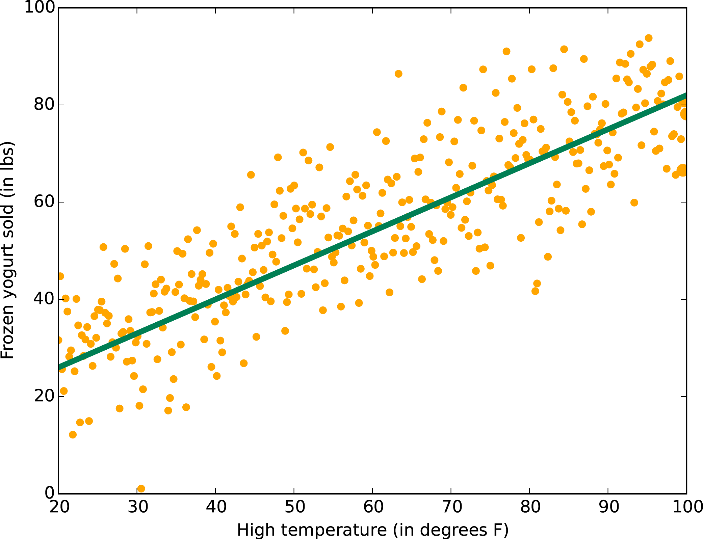
This Algorithm finds a correlation between input x and output y and uses that to improve certain tasks. 

Data with a linear trend

Example of a machine learning model based on linear regression.

For example: A skin cancer detecting algorithm created by Stanford Artificial Intelligence Laboratory and Stanford Medical School, that uses a database of 1,30,000 skin disease images, has been proven to be just as effective at detecting skin cancer as a team of 21 certified dermatologists. 

Such applications of Machine learning can actually save lives and reduce the time and costs involved in detection of diseases. 

Interesting Fact about Machine learning: This term “Machine Learning” was coined by computer gaming and artificial intelligence trailblazer, Arthur Samuel, way back in the year 1959. 

Applications of Machine Learning

As evident from the previous examples, machine learning has a wide range of applications, in almost all industries. From agriculture to healthcare, it can find its application wherever a large quantity of data can be provided.

Let’s look at some interesting examples:

  • The Deep Blue was a chess playing computer created by IBM, which was the first computer ever to be able to defeat a reigning world champion (Garry Kasparov) in a chess game and a chess match under regular time controls.
  • Academic publisher Springer Nature has published a research book in 2019 titled “Lithium-Ion Batteries: A Machine-Generated Summary of Current Research”written completely generated using machine learning.
  • Machine learning plays a major role in the development of self-driving cars
  • Search engine optimization also works on the basic principles of machine learning
  • And in his way, if we pay a little more attention to the technology that we use, we will find several examples of machine learning in our life.  

Limitations of Machine Learning

Although machine learning has transformed several fields completely and will continue to do so, we must acknowledge its limitations. The limitations in machine learning mostly arise due to lack of suitable data, biases in data collection, privacy or improper algorithms. 

Let’s see some examples of the limitations of machine learning:

  • In 2016, Microsoft tested a chatbot for twitter, which after learning from existing tweets started posting with racist and sexist language. (This is an example of unsuitable data)
  • In 2018, an Uber self-driving car failed to detect a pedestrian who was killed after collision. 
  • Machine learning is also an expensive technology. IBM’s Watson system which was expected to play a huge role in healthcare failed to give desired results even after billions of dollars of investment. 

Thus, we can see that even though machine learning is a transformative technology that has he potential to transform our lives, it must be managed with the utmost care, keeping in mind the consequences that may occur from its use.  

Graph used is from: https://docs.microsoft.com/en-us/azure/machine-learning/studio/algorithm-choice

How to Get Your Way with Statistics

By Ali Hyder Mulji

“If you are a heavy French fry eater, your risk of dying doubles!”

Haven’t we all heard sentences like this, one too many times and are always left dumbstruck by the claims they make? Sometimes they’re too awful to be believable but at most others, its simply a smart statistician slyly fooling laymen using mathematical jargon. It is not that sentences like these are erroneous per se but they tend to bend the truth in a manner that still keeps the statistician “honest”

Let’s look at 3 ways in which statisticians use their confusing jargon to fool people.

  1. The Well-Chosen Average 

Imagine your broker convinces you to shift to a locality by saying that the average income of people there, is 20,00,000 Rupees and naturally you would expect to meet several upstanding and educated people there. However, after shifting you, you’re told that the average income of people is actually only 7,00,000. You’d assume at first that your broker fudged the numbers but actually he was technically correct. 

The concept used here is actually that of choosing the correct average to suit your needs. As we all know there are three different kinds of averages: mean, median and mode. In several cases like the average height of people in a country or the average attendance of people in a class, the three averages will fall at roughly the same place. In financial terms however, such is not the case.

The following graph explains it clearly. 

This is called a skewed distribution where the data is not symmetrical. In these cases, the extreme values do not cancel out each other as would have been in the case of a bell-shaped curve as shown here: 

2) The Real Risk

“If you are a heavy French fry eater, your risk of dying doubles!” 

Let’s analyse the above statement thoroughly. The statement makes a bold claim but does not go far enough to explain how many or how often do we have to eat French fries before we actually double our risk of dying. 

The study was conducted by the American Journal of Clinical Nutrition and concluded that eating French fries does double your risk of death. However, it also said that the result only applies if a person eats fried potatoes more than 3 times a week So let’s take an average person in this study: a 60-year-old man. What is his risk of death, regardless of how many French fries he eats? One percent. That means that if you line up 100 60-year-old men, at least one of them will die in the next year simply because he is a 60-year-old man. Now if a 60-year-old man actually eats fried potatoes more than 3 times a week, his chances of dying double. But what’s the double of 1%? 2! And that man also gets to eat fried potatoes more than 3 times a week for his ENTIRE LIFE! Sounds like a win-win to me.

This is called Relative Risk. If your chances of winning the lottery are 1 in a billion and someone offers you a special ticket that increase your chance of winning by ten times, the probability that you will win the lottery will still be only 10 in 1 billion. 

3) Small Sample Sizes

“Users report 23% fewer cavities by the use of Colgate!”

In the world we live in, it is hard to believe that any one toothpaste can show better results than any other. After all, 9 out of 10 dentists are always in support of any random toothpaste. The fallacy behind this study lies in the sample size chosen. On several occasions the companies silently omit such important information from detailed study reports. This is how you could conduct a similar study that works in your favour and still get it approved by every authority out there. 

Step 1: Get a small number of people to join a random college association, say, their college Math Club.

Step 2: One of three things could happen. Their attendance falls, remains the same or increases. 

Step 3: Repeat the above steps until, by the principle of operation, you arrive at a situation where the attendance of students increased substantially. (The principle of operation basically says that if repeated enough number of times all possibilities will occur sooner or later.)

There you have it! A headline that goes by the lines “Students say joining the Math Club has resulted in increased attendance by n% !”

Another example would be: 

Step 1: Toss a coin 10 times

Step 2: Note down the results. You can have 1024 possible outcomes ranging from HHHHHHHHHH to TTTTTTTTTT 

Step 3: Choose an arbitrary outcome, say, HHHHTTHHHH

Step 4: Here the number of times you got a head is 8 which is 80% instead of 50%. You can now conclude that you have proven that tossed coins have an 80% chance of showing heads. Although do mention the exact details of the study… somewhere in the corner… in small font. 

(If repeated enough times the Law of Averages will eventually result in a 50% probability of Heads and Tails)

Note: Some concepts in this article are from the book How to Lie with Statistics by Darrell Huff.

You’ll Never Look at a Deck of Cards the Same Way Again

By Parth Mehta

It all starts with a simple deck of playing cards. These 52 thin cardboards with colorful designs printed on their sides seem pretty much harmless enough. Yet as they say, the complexity of things begins from the simplest systems. So, A harmless question. In how many ways can they be arranged?

For this we need to understand the mathematical operation factorial (!). In simple terms, Factorial is the operation of multiplying any natural number with all the natural numbers that are smaller than it, For Example: 4! = 4 × 3 × 2 × 1 = 24

You can visualize the arrangements by constructing a randomly generated shuffle of the deck. Start with all the cards in one pile. Randomly select one of the 52 cards to be in position 1. One of the remaining 51 cards for position 2, then one of the remaining 50 for 3, and so on. Hence, the total number of ways you could arrange the cards is 52 × 51 × 50 ×… ×3 ×2 ×1, or 52! I think the exclamation mark, the symbol for the factorial operator is to highlight the fact that this function produces surprisingly large numbers in a very short time! Factorial intended 🙂

The richness of most card games owes itself to this fact that the number of variations that these 52 cards can produce is virtually endless. If you have a pocket calculator, that maxes out at 12digits, an attempt to calculate the factorial of any number greater than 14 results only in value of “Error”. So, if 15! will break a typical calculator, how large is 52!? Who says you can’t create history? It’s as simple as shuffling cards.

Would you believe every time you gave the deck a proper shuffle, you were holding a sequence of cards which never existed in the history of all mankind? No one has, and likely never, ever held the exact same arrangement of 52 cards you just did.

Shall we play a game? Let’s Permute this!

  • Start a timer that will count down the number of seconds from 52! to 0.
  • Choose your favorite spot on the earth’s equator. You have to circumvent the Earth along the equator. But there’s a catch — you can only take one step every billion years. [A billion years equals 3.155 × 1016seconds]

(Did I lock the door before leaving?)

  • After you complete one journey around the equator and reach the point where you started, remove one drop of water from the Pacific Ocean. 

[The equatorial circumference of the Earth is 40,075,017 meters, according to WGS84]

  • Now repeat the whole process — walk around the Earth at one billion years per step, removing one drop of water from the Pacific Ocean every time you circle the globe. Continue until the Pacific Ocean is empty. 

[There are 20 drops of water per milliliter, and the Pacific Ocean contains 707.6 million cubic kiloliters of water]

(Is there a full stop to this?)

  • After you have emptied the Pacific Ocean, Pick a sheet of paper and place it flat on the ground. Fill the ocean back up and start the entire process all over again, adding a sheet of paper to the stack every time the ocean is emptied. Do this until the stack of paper reaches the Sun. Once the stack reaches the Sun take it down and do it all over again. One thousand times more.

(How. Long. Has. This. Been. Going. On!?)

Surely the timer must have reached 0 by now?

Nope.

You’re only done with one-third of the time!

(And you thought afternoons were boring)

  • To pass the remaining time, start shuffling your deck of cards. Every billion years deal yourself a 5-card poker hand. Each time you get a royal flush, buy yourself a lottery ticket. A royal flush occurs in one out of every 649,740 hands.
  • If that ticket wins the jackpot, throw a grain of sand into the Grand Canyon. Keep going and when you’ve filled up the canyon with sand, remove one ounce of rock from Mt. Everest. Now empty the canyon and start all over again. 
  • When you’ve levelled Mt. Everest, look at the timer. You still have 5.364 × 1067seconds remaining. Mt. Everest weighs about 357 trillion pounds. You barely made a dent. If you were to repeat this 255 times, you would still be looking at 3.024 × 1064seconds. The timer would finally reach zero sometime during your 256th attempt. Exercise for the reader: at what point exactly would the timer reach zero?

Back to the seat comrades!

Sorry to break it to you, Of course, in reality none of this could ever happen. The truth is, the Pacific Ocean will boil off as the Sun becomes a red giant before you could even take your fifth step in your first trek around the world. However, Somewhat more of an obstacle is the fact that all the stars in the universe will eventually burn out leaving space a dark, ever-expanding void by the time you remove a milliliter of water from the pacific (Not to forget the pacific is already boiled-off).

MIND=BLOWN

By the way,

52! = 52 × 51 × 50 ×… ×3 ×2 ×1= 80658175170943878571660636856403766975289505440883277824000000000000

[Visualization and statistics from Scott Zcepiel]

Design a site like this with WordPress.com
Get started