Relationship between Math and Music

By Aditi Madan

“There is geometry in the humming of the strings, there is music in the spacing of the spheres.” -Pythagoras

Would you believe that research has shown that certain pieces of music end up being more popular and mainstream due to their ‘mathematical’ structure?


Besides the basic uses of mathematics in music theory and notation (such as chords, time signatures, or dotted half-notes that represent a count of three), music has also been the source of research in many areas of mathematics such as abstract algebra, set theory and number theory. The link between the physical practice of music and strong mathematical abilities are demonstrated in studies that show that kids who play a musical instrument can perform more complex arithmetical operations than those who do not play an instrument. The slow work of practice, the attention to detail and the discipline it takes to learn an instrument are also excellent preparation for the practice involved in building strong math skills.
History of Relationship between Music & Math 

Music has long played for performance and pleasure, yet the study of music, particularly its relation to mathematics, has been going on for equally as long as music for performance. From Greeks to Egyptians to Indians to Chinese, nearly every ancient civilized culture has examined the connection between music and mathematics. Famous philosopher Plato was known to have an extreme interest in music, particularly harmonies, and helped highlight their importance within both an individual and society. Plato wasn’t the only philosopher who found the importance of studying the relationship between music and mathematics.

What exactly is the connection between music and mathematics? 

It is interesting to note that all fields of music including the Western melodic patterns, the Hindu raga, the Japanese pentatonic scale, etc. conform to a mathematically derived code. This is especially true of Indian classical music where the concept of ‘taal’ or metre, is intrinsically linked to numbers. The connection between the two was never doubted in the past, but rather music and mathematics comprised as a single whole concept. Wayne Parker, senior researcher at Hopkins’s Institute for the Academic Advancement of Youth, comments upon the divide which has emerged between the two. “Today we think in terms of math/science people or verbal/artistic people. There’s that division. In the past, math, music, and reading held the liberal arts together.”

Reiterating this fact is Shankar Mahadevan, famous Indian singer, music director and composer. “I never really connected the dots between music and maths,” says Shankar Mahadevan, who holds an engineering degree in Computer Science from Mumbai University, India. “But maybe learning to play the harmonium and veena before I was five, helped develop my mathematical skills without my realizing it.’

Mathematics in musical instruments

A simple willow flute gives out soothing music, thanks to the mathematics applied while making it. The willow flute is around 50cms in length and has a wooden plug at one end, with a hole at a short distance from the end. The sound is produced by blowing into the flute with varying force while covering the whole hole or a part of it, say one-fourth or half of it. Leaving the end open produces a fundamental tone with its overtones, while keeping it closed produces a different harmonic.

The Fibonacci series consists of a series of numbers in which the present number is the sum of its two preceding numbers. In music, this can be seen in piano scales where the keys form a golden ratio (1.618) – the ratio formed in the Fibonacci sequence.
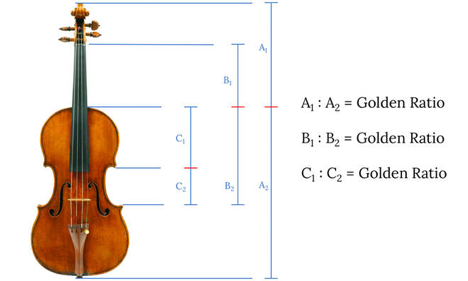
Violins have four different strings – G, D, A, E. Creating a note involves the string vibrating at their fundamental frequency. The relationship between the fundamental harmonic and the rest of it can be expressed by a sinusoidal equation.
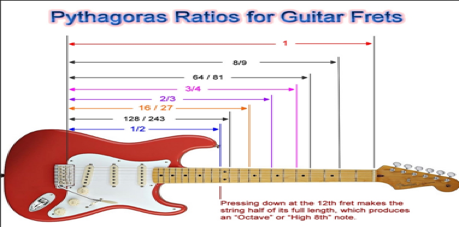
The simplest example is illustrated above with an electric guitar. When a string is played, and then that same string pressed half-way along its length (in the guitar’s case the 12th fret), then we get the same note – this is a whole octave.

Pythagoras and Frequency

It was Pythagoras who realized that different sounds can be made with different weights and vibrations.  This led to his discovery that the pitch of a vibrating string is proportional to and can be controlled by its length.  Strings that are halved in length are one octave higher than the original.  In essence, the shorter the string, the higher the pitch.  He also realized that notes of certain frequencies sound best with multiple frequencies of that note.  For example, a note of 220Hz sounds best with notes of 440Hz, 660Hz, and so on. 

The closest tie between music and math is patterns.  Musical pieces often have repeating choruses or bars, similar to patterns.  In mathematics, we look for patterns to explain and predict the unknown.  Music uses similar strategies.  When looking at a musical piece, musicians look for notes they recognize to find notes that are rare (high or low) and less familiar.  In this way, notes relate to each other.  Relationships are fundamental to mathematics and create an interesting link between music and math.

Wave Frequencies

When we listen to music, we assume that we are hearing a song or a collection of notes, but what our brains are actually processing are sound waves. For example, when a note is played, sound waves travel from an instrument or amplifier and reverberates on our ear drums, and it’s the frequency of this sound wave that tells our brain which pitch or note is being played (e.g. the E above middle C reverberates at approximately 329.63 Hz). Understanding sound waves, particularly the difference between octave notes, requires a bit of mathematics and physics. To find the frequency of a given note, take a constant note (which traditionally is the A above middle C, which contains a frequency of 440Hz) and multiply it by the twelfth root of 2 to the power of the amount of half steps away your desired note is from middle A (if the note is below middle A, make the power a negative). If that confuses you, don’t worry! Below is an example of how to find the frequency of middle C:

  • Frequency of Middle C
  • = 440Hz * 2 (1/12) to the negative 9th power (middle C is 9 half steps below A)
  • =440Hz * 0.59460
  • = ~261.625

CONCLUSION

Whatever links between music and mathematics exist, both of them are obviously still very different disciplines, and one should not try to impose one on the other. It would be wrong to attempt explaining all the shapes of music by mathematical means as well as there would be no sense in studying mathematics only from a musicological point of view. However, it would be enriching if these relationships were introduced into mathematical education in order to release mathematics from its often too serious connotations.

It is important to show people that mathematics, in one way, is as much an art as it is a science. This probably would alter its common perception, and people would understand better it essence and universality. This task, however, will certainly not be completed by the end of this century.
InsurTech

By Krisha Shah

InsurTech is the new cool word within the vocabulary of the financial services, replacing the term FinTech, which established itself in the last years of 2000 when companies like Square, Transfer wise, and Stripe accelerated the payments revolution launched by PayPal in the US and Alipay in China. However, I believe that InsurTech does not have yet a clear, agreed, and established definition. So all technologies at the forefront of insurance innovation, such as artificial intelligence, chatbots that enable H2C (Human to Customers) in distribution, as well as advanced analytics that are looking for the right use cases in the data-driven business of insurance, need to fit and find their own space in the definition and concept of InsurTech, which has increased significantly.

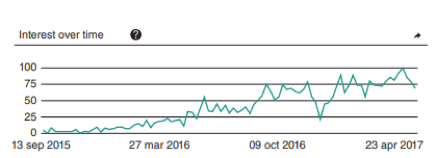
Figure 1: InsurTech interest over time based on Google research.

The optimal insurance company has three “employees”: a computer, a dog and an actuary. The computer runs the insurance company, the actuary feeds the dog and the dog bites the actuary if they try to touch the computer. This joke has supposedly been making the rounds among insurtech companies, which are shaking up an industry that has traditionally been slow to adopt new technologies. 

There are at least three approaches that characterize the InsurTechs’s way of working:

1. Leverage the most advanced technologies. The most innovative technologies are the core of any InsurTech’s solution. InsurTechs are early adopters of innovative technologies and apply them to the insurance business, develop PoV, productize their solution, and offer it to insurance incumbents often creating the needs and the demand for a specific technology that the insurance business didn’t perceive before. IIt is equally unsurprising that technologies such as auto telematics, drones, or blockchain were brought to the market by InsurTechs rather than insurance incumbents.

2. Focus on improving the experience to foster a user-centric approach. InsurTech entrepreneurs’ focus on improving the experience could be improving the purchasing journey of a customer, supporting underwriters during risk valuation, or helping loss adjusters in the loss assessment. Regardless, the InsurTech obsession is (and must be) improving the experience following a user-centric approach. InsurTechs improve customer centricity by developing new customer value propositions and products that simplify the clients’ user experience in a sector that traditionally lags behind other industries in clarity and usability. The solutions that simplify and improve the underwriting process, the lead allocation mechanisms, and the claims management have an impact on the bottom line as relevant as the one that the InsurTechs focusing on customer experience have on the top line.

3. Have an agile culture and approach and leverage advanced analytics to take business decisions. InsurTech startups are very often developed by technology-driven entrepreneurs who are young and digital natives. . They are not afraid to quickly develop, test, and bring innovations to the market following a lean and agile approach; they embed advanced analytics in their management practices and operations to generate insights and take business decisions on a day-to-day basis.

Why is insurance industry falling?

The Challenge

 There is no tangible product delivered within most insurance transactions. The most risk averse individuals will buy it. The least risk averse will self-insure. However, no-one really wants insurance until they really need it. The customer only buys trust – or a promise of trust when times are hard. This tempts intermediaries to sell insurance using the tactics of fear and commoditization. Front-loaded commissions can lead to a tendency to secure sales irrespective of need. This propensity may lead to misrepresentation; it leads to dissatisfaction; temptation leads to fraud; suspicion and a breakdown of trust lead to dysfunctional claims systems; and so it goes. The cycle of fraud in the industry has undermined the true benefits of insurance for a long time. The industry has no product other than trust. If the customer considers the trust to be compromised, there is nothing left. The bigger question is perhaps whether InsurTech needs the incumbents in insurance. Before we address this issue let’s step back and look at how we arrived here.

Digital Transformation in Insurance

 1. From non-transparent markets to customer transparency. 

In the past, customer market interactions, whether buying services or trading goods, were portrayed by the limited possibility to compare these with local agents or retailers. With the emergence of readily accessible information, this local focus widened and allowed for 24/7 active comparison and competition, e.g. via online direct sales or price comparison sites. In most Business to Customer (B2C) areas, the customer is now also able to validate a purchase intention based on peer reviews, which reduce again, at least perceived, uncertainty. The next level of transparency with the reduction of complexity – the matching of the customer’s available data with an automated customized offering of products – is already market standard for industries like fashion, news, music, and movies.For the insurance industry, especially in the sales of Property and Casualty (P&C) and other standardized products, this means a dramatic shift

2. Substitution of Middle Man – Direct Producer-to-Customer Connection

 Digital advancements have allowed companies to offer products and services directly to the customer. Online platforms, ecosystems, and engines are the new middle man and they are substituting (parts of) the traditional supply chain and sales channels. In many industries new players have emerged, especially in retail, such as Amazon, Alibaba, and Rakuten, but also in, for example, aggregating transportation like Uber, Gett, and food delivery, e.g. UberEats and Takeaway.com. Similar mechanisms will occur in the insurance industry. In a world where “online”/“cloud” is nowadays common for the consumer, intermediation will be based on, inter alia, social media profiling; automated recognition of needs; and guided, short, and simple customer data input. Easy to purchase (and cancel) products, direct- and event-based sales, and finally an automated real-time, traceable claims process will substitute the traditional broker.

3. From Many Scattered Players with High Margins to Few Scaled Players with Low Margins

 The aggregation of data and automated processes have enabled scalable digital business models that can easily survive with small product margins. Transparency and intermediation transformation has already resulted in fundamental change to many localized, fragmented players like taxi services, lottery, fashion retail, and web services. In insurance, we still see a localized, fragmented market, with many small players scattered across all sectors, nearly all with fully integrated, selfbuilt legacy-heavy value chains. New players are, for example, pure white-label insurance carriers like Element or “insurance factories” like one that can be plugged into their business client’s system with open application programming interfaces (APIs). Their focus will be on core business systems, i.e. underwriting and processing specialized, individual products – ranging from B2C to B2B2C, from unit size one to large scale roll-out – and could accelerate to industry leadership at unprecedented speed.

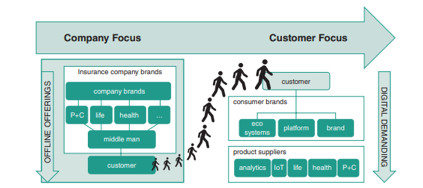
4. From Supply-driven (Company Focus) to Demand-driven (Customer Focus) 

This trend aggregates an individual customer-centric focus to the company level. As product purchases will be channelled through, e.g., ecosystems, the primary point of contact and visibility of insurance companies will shift. The impact of focusing on the customer instead of the company is illustrated in Figure 1. Product suppliers, as well as sales, are currently powerful, mostly vertically-integrated, independent units within larger incumbents. However, they will face the impact of becoming supply factories, providing on-demand, efficient services at lowest unit cost. It will be critical to cater to customer demand whenever, wherever, and via whatever intermediation, through diverse but fullyintegrated sales channels (via client relationship management (CRM) systems), whether directly attached to products (e.g. cars, electronics), external plug and play solutions, internal direct sales, or branded ecosystems.

InsurTech now and Going Forward

 For many, InsurTech paints the picture of a full-stack insurer that solves and does all I have described as a digitally-native carrier, acquiring customers through the promise of better pricing and experience, while simultaneously giving more than just risk coverage to extract a better customer lifetime value. For me, InsurTech is something broader and may, in some cases, make incumbents invisible and parametric. We may not even recognize a product, technology, or software to be transformative for the insurance industry; the best InsurTech might not be identified as InsurTech at all. Insurance is undergoing an industrial revolution, and, in doing so, all aspects of the value chain will both evolve proactively due to InsurTech, and InsurTech will reactively produce new solutions to serve the ecosystem. Broadly speaking, the taxonomy will follow these pieces of the value chain (distribution, claims, underwriting, and so forth) and the different product lines across life, non-life, and health insurances. However, even this will evolve over time as new buzzwords and new industry-wide trends emerge. As the automobile and mobility industry evolves, so will the corresponding insurance industry.

Game Theory

By Anisha Mata

Game Theory is a concept that we hear about a lot in the 21stcentury. Its applications range far and wide, across disciplines and fields. A working knowledge of game theory can help you figure out the best strategy, whether that’s for a game like rock, paper, scissors or negotiating a deal with your competitor. So, let’s try to understand this concept.

Interesting Fact: 11 game theorists have won the Nobel prize for Economics for their contribution to Game theory.

Game Theory is essentially a model for decision making and strategy that involves weighing the benefits of each choice as well as the interaction between the participants. The main objective of game theory is to predict the optimal decision the participants will make in a particular situation, assuming that the players are rational and will strive to maximize their gains. 

Game Theory Definitions:

Let’s begin by defining a few words that are commonly used in Game theory.

  • Game: Situations or circumstances, the results of which are dependent on the actions of two or more participants/decision-makers.
  • Players:The participants that take decisions in the context of a particular game.
  • Strategy: A concrete plan of actions that a player will take considering all circumstances of a game.
  • Payoff/Gains: The payout that the player receives from arriving at a particular point after taking a particular decision or set of decisions.
  • Equilibrium: The point in the game where all players have taken their decisions and an outcome is reached. 

Interesting Fact: According to game theory, the actions and decisions of each player affects the outcome of every other player.

Game Theory in action:

A very popular example of Game Theory is the Volunteer’s Dilemma.

The Volunteer’s Dilemma involves a situation in which one volunteer can make a small sacrifice that benefits everybody, or instead wait to receive the benefits from someone else’s sacrifice. The worst possible outcome is if no one volunteers.

Let’s take a situation where the water supply for an entire neighborhood has stopped. All the inhabitants are aware that the supplier will fix the issue if at least one person calls to notify them. If no one volunteers, the worst possible outcome is the fate of all participants and the water supply doesn’t resume until the supplier themselves realize the issue. However, if only one-person volunteers to call for public wellbeing, all the inhabitants benefit from it.

Social phenomena of the Bystander Effect and the Diffusion of Responsibility heavily relate to the Volunteer’s dilemma.

Another, more advanced application, of Game Theory is the Ultimatum Game.

In the Ultimatum game there are two players, namely, the proposer and the responder.  The game takes place as follows:

The players are given a certain sum of money, let’s say Rs. 100. The Proposer must propose how the Rs. 100 will be split. He/she can take Rs. 5 or Rs. 50 or any such division. However, the responder must decide whether he/she accepts the proposal. If the responder rejects the proposal, then neither of the two receive any money. 

In every situation, it benefits the responder to accept the proposal. The worst possible outcome in this situation is that neither of the players receive anything. Hence, the optimal decision will be to accept. 

Another famous example of Game Theory is the Prisoner’s dilemma.

Let’s assume that two criminals have been arrested for a crime. However, there is no solid evidence against them. So, in order to get confessions, the prosecutors decide to question them separately. This way, neither of them has any idea what the other has said. So, there are actually two decisions available to each prisoner, which means there can be 4 different outcomes:

  1. Both prisoners confess and get a 5-year prison sentence each.
  2. Prisoner 1 confesses but prisoner 2 doesn’t. Prisoner 1 gets a 3-year prison sentence and prisoner 2 gets a 10-year prison sentence. 
  3. Prisoner 2 confesses but prisoner 1 doesn’t. Prisoner 1 gets a 10-year prison sentence and prisoner 2 gets a 3-year prison sentence. 
  4. Neither of them Confess and they get a 2-year prison sentence each.

The best possible outcome would be that neither of them confess. However, since they cannot know for sure whether or not the other will confess, they will likely both end up confessing and getting a 5-year prison sentence each.

The prisoners take the decision best for them individually but worse for them collectively. 

In this way, game theory can be applied to a multitude of situations. 

Interesting Fact: During the Cold War between the United States and Soviet Union, strategic decisions taken by each nation was viewed as an example of game theory in real life.

Limitations of Game Theory:

Even though game theory has various applications and can help in making optimal decisions, it is not perfect. The biggest limitation of game theory is that it assumes that humans are rational players that always act in self-interest and for the purpose of maximizing utility. However, this is not always the case. Human Beings are social animals that at times cooperate and care about the welfare of others, especially those in our community. Game theory, at times, fails to take into account the social context in situations and the nature of the relationship between the players.

Interesting Fact:The phrase “tit for tat” is often used in game theory to describe a situation when a player responds with the same action used by the opponent in the previous turn. 

Game theory has applications in fields such as economics, psychology, evolutionary biology, warfare, politics as well as business. And despite its impressive advances in the last century, it is still a young and developing science, which will require individuals with multidisciplinary knowledge and skills to take it forward and expand the limits of human understanding.  And that’s why we’ll continue to explore game theory in a series of article coming up soon!

Welcome!

This is a blog maintained by the Mathematics and Statistics Cell of Narsee Monjee College of Commerce and Economics, Mumbai. Here we will be talking about interesting and dynamic concepts in the fields of Maths and Statistics, sharing our ideas and turning complicated theories into practical and understandable examples.

We hope we are able to ignite your interest in the field of Mathematic and help you accelerate your learning and expand your horizons as we discuss topics like Machine Learning, Data Science, Algorithms and much more!

Design a site like this with WordPress.com
Get started